Is SEO Dead? How GEO is Taking Over in 2026
The digital marketing industry is changing rapidly in 2026. With the rise of artificial intelligence, search engines are becoming smarter and more conversational than ever before. Many marketers and business owners are now asking one important question: Is SEO dead?
The answer is simple — SEO is not dead, but it is evolving. Traditional SEO methods alone are no longer enough to achieve top visibility online. A new strategy called Generative Engine Optimization (GEO) is transforming how websites rank in AI-powered search environments.
As businesses adapt to this shift, professionals are increasingly joining digital marketing courses in Pune to learn AI-driven SEO strategies and future-ready marketing skills.
Table of Contents
What is Traditional SEO?
Traditional SEO (Search Engine Optimization) focuses on improving website visibility in search engines like Google through techniques such as:
- Keyword optimization
- Backlink building
- Technical SEO
- Meta tags
- Content optimization
For years, these methods helped websites rank higher in search engine result pages (SERPs).
However, search engines are now powered by advanced AI systems that understand context, user intent, and conversational language.
Why Search is Changing in 2026
Search behavior has changed dramatically over the last few years.
Earlier, users searched using short keywords like:
- “best SEO tools”
Now users ask conversational questions such as:
- “What are the best AI SEO tools for beginners in 2026?”
AI-powered search engines are designed to understand these natural language queries and provide direct answers instead of just listing websites.
This shift is changing the entire SEO industry.
What is GEO?
Generative Engine Optimization (GEO) is the process of optimizing content for AI-powered search engines and conversational AI platforms.
Unlike traditional SEO, GEO focuses on:
- User intent
- Conversational content
- Semantic relevance
- AI readability
- Helpful information
The goal of GEO is to help content appear in:
- AI-generated answers
- Voice search results
- Conversational search platforms
- AI summaries and recommendations
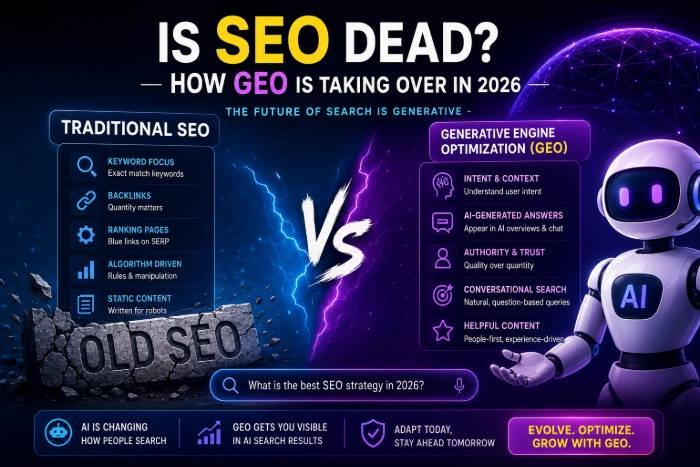
GEO vs Traditional SEO
| Traditional SEO | GEO |
|---|---|
| Focuses on keywords | Focuses on intent & context |
| Optimizes webpages | Optimizes AI-generated answers |
| Ranking-based strategy | Conversational visibility |
| Depends heavily on backlinks | Prioritizes authority & trust |
| Short search queries | Natural language search |
Google’s Focus on Helpful Content
Google’s latest algorithm updates prioritize:
- Helpful content
- User experience
- Expertise and trust
- Originality
- Semantic relevance
Search engines now reward content that genuinely helps users instead of content created only for rankings.
This means keyword stuffing and low-quality AI-generated content are becoming less effective.
Why GEO is Growing Fast
1. AI Search is Becoming Mainstream
AI-powered search tools and conversational AI platforms are growing rapidly.
Users now rely on:
- AI assistants
- Voice search
- AI-generated summaries
- Conversational search engines
Businesses need GEO strategies to remain visible in these platforms.
2. Conversational Search is the Future
People naturally speak in questions rather than typing short keywords.
Example:
Instead of:
- “SEO trends”
Users ask:
- “What are the latest SEO trends in 2026?”
GEO focuses on optimizing content for these conversational queries.
3. User Intent Matters More
Modern AI systems analyze:
- Why users search
- What information they need
- What problem they want to solve
This is why user-focused content performs better in AI-powered search environments.
Important GEO Strategies in 2026
Create Conversational Content
Write naturally and answer user questions clearly.
Focus on Semantic SEO
Use related topics and concepts instead of repeating keywords excessively.
Improve Content Quality
AI systems prioritize:
- Helpful information
- Original insights
- Well-structured content
Optimize for Voice Search
Voice searches are longer and conversational, making natural language optimization important.
Build Authority and Trust
Trusted and experience-driven content performs better in AI search systems.
Is Traditional SEO Still Important?
Yes, traditional SEO still matters for:
- Technical optimization
- Website speed
- Mobile responsiveness
- Indexing
- Structured data
However, SEO alone is no longer enough. Businesses now need a combination of:
- Traditional SEO
- AI SEO
- GEO strategies
This hybrid approach is the future of digital visibility.
Impact of GEO on Digital Marketing
Generative Engine Optimization is changing the digital marketing industry in many ways.
Content Marketing
Content now needs to be:
- Conversational
- Helpful
- User-focused
Search Strategy
Businesses must optimize for AI-generated search experiences.
Brand Visibility
Companies using GEO can appear in AI-generated recommendations and summaries.
Customer Experience
AI-friendly content improves engagement and personalized interactions.
Why Learning GEO is Important
The future of digital marketing is closely connected with artificial intelligence.
Learning GEO helps marketers:
- Stay updated with AI search trends
- Improve online visibility
- Build future-ready SEO skills
- Gain better career opportunities
This is why many students and professionals are choosing digital marketing training in Pune to learn AI SEO, GEO, and advanced digital marketing techniques.
Future of SEO and GEO
The future of search will become more:
- Conversational
- Personalized
- AI-driven
- Intent-focused
Businesses that continue using only outdated SEO techniques may struggle to maintain visibility.
Companies that adopt GEO early will gain a strong competitive advantage in the AI-powered digital world.
Conclusion
SEO is not dead in 2026—it is evolving into something smarter and more user-focused. Traditional SEO techniques still play an important role, but Generative Engine Optimization (GEO) is becoming essential for success in AI-powered search environments.
Businesses and marketers must focus on:
- Helpful content
- User intent
- Conversational optimization
- Semantic SEO
- AI readability
The future belongs to brands that create valuable, authentic, and AI-friendly content experiences.
FAQs
1. What is GEO?
Generative Engine Optimization (GEO) is AI-focused SEO that helps content appear in AI-generated search results and conversational search platforms.
2. Is SEO dead in 2026?
No. Traditional SEO is evolving into AI SEO and GEO strategies.
3. How is GEO different from SEO?
SEO focuses on keywords and rankings, while GEO focuses on user intent, AI readability, and conversational search.
4. Why is GEO important?
AI-powered search engines are growing rapidly, making GEO essential for online visibility.
5. Does AI-generated content rank on Google?
Yes, if the content is high-quality, helpful, and user-focused.
6. What are the best GEO strategies?
- Conversational content
- Semantic SEO
- User intent optimization
- Helpful content creation
7. Why should marketers learn GEO?
GEO helps marketers stay future-ready in the AI-driven digital marketing industry.
Read More: Social Media vs. SEO Which Digital Marketing Strategy Works Better?