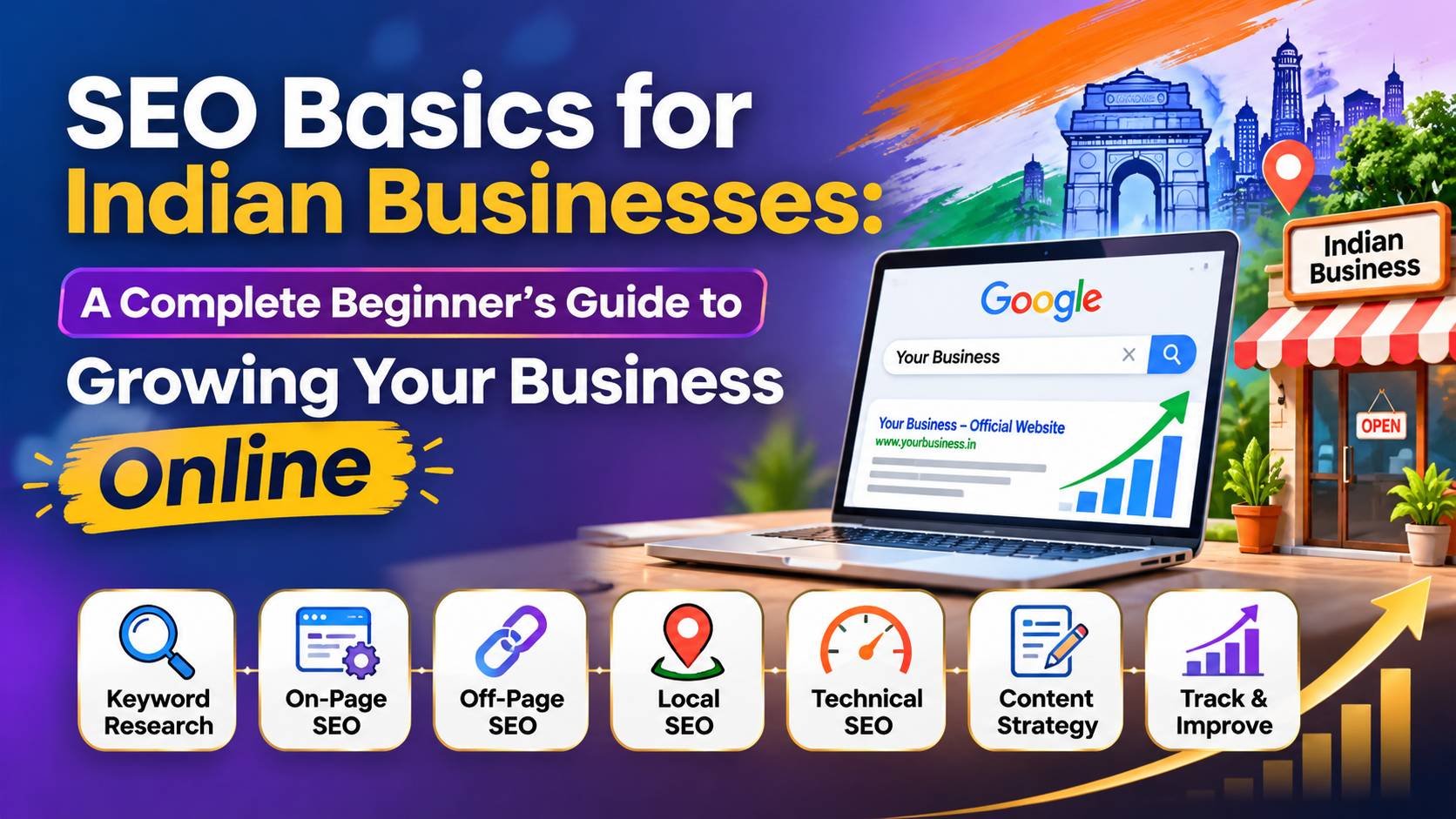
SEO Basics for Indian Businesses: Growing Your Business Online
Having a website alone is not enough to grow your business in today’s digital world. Indian businesses should ensure their websites show up in Google search results when customers look for their products or services. That’s where Search Engine Optimization (SEO) comes in. Whether you have a small business, startup, service company, or e-commerce store, SEO can help you get more visitors, generate quality leads, and boost sales without relying only on paid ads. Many entrepreneurs and professionals are also taking digital marketing courses in Pune to learn SEO and other online marketing skills.
Table of Contents
1. What Is SEO?
Search Engine Optimization (SEO) means making your website more visible on search engines like Google and Bing. The main goal is to help your website show up higher in unpaid search results when people look for information, products, or services related to your business.
For example, imagine you own a bakery in Pune. When someone searches for “best bakery near me” or “birthday cake shop in Pune”, you want your website or Google Business Profile to appear among the top relevant results.
SEO helps achieve this by optimizing different elements of your website, including:
- Website content and keywords.
- Page titles and meta descriptions.
- Website loading speed.
- Mobile responsiveness.
- Internal and external links.
- Local business information.
- User experience and website structure.
SEO is not something you do just once. It’s a continuous process that needs regular checks, content updates, technical fixes, and ongoing keyword research.
2. Why Is SEO Important for Indian Businesses?
India has a rapidly growing internet audience, and consumers increasingly use search engines to discover local businesses, compare products, read reviews, and make purchasing decisions.
SEO gives small and medium-sized businesses a chance to compete with bigger brands by targeting the right searches and sharing helpful information.
Here are some important benefits of SEO for Indian businesses:
- Increases Website Visibility
SEO helps your website show up in the right search results. When your site is more visible, more potential customers can find your business.
- Generates Organic Traffic
With organic search traffic, you don’t have to pay for every click as you do with ads. If your page is well-optimized, it can keep bringing in visitors for a long time.
- Builds Brand Credibility
People usually trust businesses that show up at the top of search results. Sharing helpful content, earning good reviews, and keeping your business info accurate can build your online reputation.
- Supports Local Business Growth
Local SEO lets businesses connect with customers in their area. For instance, a salon in Pune can target searches like “best salon in Baner” or “hair salon near Wakad”.
- Improves Lead Generation
SEO brings in people who are already looking for your products or services. That’s why organic search is a great way to get relevant inquiries.
- Provides Long-Term Marketing Value
SEO takes time and steady effort, but the results can keep helping your business even after you finish certain tasks.
3. Understand How Google Search Works
Before you start SEO, understand how search engines find and display your website content.
Google generally follows three major processes:
- Crawling
Google uses automated programs called crawlers or Googlebots to discover web pages. These crawlers follow links and examine website content to identify new and updated pages.
- Indexing
After discovering a page, Google analyzes its content, images, videos, and other information. If the page is eligible, Google may store it in its search index.
- Ranking
When someone searches on Google, its ranking systems evaluate many signals to identify relevant and useful results.
These signals can include:
- Content relevance and quality.
- Search intent.
- Website usability.
- Page experience.
- Location and language.
- Content freshness, where relevant.
- Page authority and reputation.
Knowing how these steps work helps you build a website that search engines can easily find, understand, and show to users.
4. Keyword Research: The Foundation of SEO
Keyword research is a key part of SEO. It means finding which words and phrases people use when searching for products, services, or information online.
For example, if you operate a digital marketing institute in Pune, your potential customers might search for:
- Digital marketing institute in Pune.
- Best digital marketing course in Pune.
- SEO training in Pune.
- Digital marketing training with placement.
- Digital marketing course fees in Pune.
These keywords show you what your target audience is looking for.
Types of SEO Keywords
Short-Tail Keywords: These are usually broad search terms containing one or two words.
Examples:
- SEO services.
- Digital marketing.
- Web development.
Long-Tail Keywords: These are more specific search phrases that usually show exactly what the user wants.
Examples:
- Affordable SEO services for small businesses in Pune.
- Best SEO agency for real estate companies.
- How to improve Google rankings for a local business.
Local Keywords: These include location-based terms customers use when looking for nearby businesses.
Examples:
- Best restaurant in Pune.
- Dentist in Kothrud.
- Digital marketing institute in Hinjewadi.
How to Find the Right Keywords
You can use different tools to identify relevant search terms:
- Google Keyword Planner.
- Google Trends.
- Google Search Console.
- Google Autocomplete.
- Google related searches.
- Semrush.
- Ahrefs.
- Ubersuggest.
Pick keywords that match your business, fit what people are searching for, aren’t too competitive, and meet your audience’s needs.
5. On-Page SEO: Optimize Your Website Content
On-page SEO means improving each page on your website so it shows up better in search engines and gives visitors a good experience. If you want to learn these skills, digital marketing classes in Pune can teach you about keyword placement, content optimization, website structure, and other important SEO tasks.
Here are the important elements of on-page SEO:
- SEO-Friendly Page Titles
Every important website page should have a unique and descriptive title.
Example:
Poor Title: Home Page
Optimized Title: Best Digital Marketing Courses in Pune | Victorious Digital
Make sure your titles are clear, relevant, and describe what the page is about.
- Meta Descriptions
A meta description is a summary of your webpage. It can help people decide whether to click your website in search results.
Example:
“Learn practical digital marketing skills at Victorious Digital, Pune. Explore SEO, Google Ads, social media marketing, and AI-powered digital marketing training.”
- Heading Tags
Use heading tags to organize your content clearly and logically.
- H1: Main page heading.
- H2: Main content sections.
- H3: Supporting subheadings.
When your headings are organized well, your content is easier for people to read and understand.
- Keyword Placement
Include your primary keyword naturally in important locations such as:
- Page title.
- Main heading.
- Introduction.
- Relevant subheadings.
- URL, where appropriate.
- Image alt text, when relevant.
Don’t overuse keywords. Make sure your content sounds natural and really helps your readers.
- SEO-Friendly URLs
Make your URLs short and descriptive so people know what the page is about.
Example:
Poor URL: www.example.com/page?id=12345
Better URL: www.example.com/seo-basics-for-businesses
- Image Optimization
Images improve your website for visitors, but large image files can slow down page load speed.
Follow these practices:
- Compress images before uploading.
- Use descriptive image file names.
- Add meaningful alt text.
- Choose suitable image formats such as WebP.
- Don’t use images that are bigger than they need to be.
6. Off-Page SEO: Build Your Website Authority
Off-page SEO means doing things outside your website to boost its reputation, trustworthiness, and visibility.
One of the most important off-page SEO activities is link building.
What Are Backlinks?
Backlinks are links from other websites to yours. Good, relevant backlinks help Google find your content and see your website as trustworthy.
For example, if a respected business publication publishes an article about your company and links to your website, that backlink may provide SEO value.
Popular Off-Page SEO Techniques
- Guest posting on relevant websites.
- Creating shareable and informative content.
- Getting listed in relevant business directories.
- Building relationships with industry websites.
- Participating in relevant online communities.
- Earning genuine customer reviews.
- Getting mentions from industry publications.
Tip: Focus on getting high-quality backlinks, not just lots of them. Don’t buy spammy links or join link schemes, as these can harm your website.
7. Local SEO: Help Nearby Customers Find Your Business
Local SEO is especially important for Indian businesses that serve customers in certain cities, towns, or neighborhoods.
For example, a restaurant in Pune wants to attract customers searching for restaurants nearby. Similarly, a dentist in Mumbai wants to appear when people search for dental services in their area.
Local SEO helps your business show up better in location-based searches.
How to Improve Local SEO
- Create a Google Business Profile
Google Business Profile allows eligible businesses to manage how their information appears on Google Search and Maps.
Add accurate information such as:
- Business name – Victorious Digital
- Business category – Training Center
- Address or service area – Pune
- Contact number – 9545022110
- Website URL –https://victoriousdigital.in/
- Business hours. Morning 9 Am to 6:30 Pm
- Products and services – Digital Marketing Courses in Pune with Placement Support
- Business photographs –
- Collect Genuine Customer Reviews
Customer reviews can affect buying decisions and help your business get noticed locally.
Ask happy customers to leave honest feedback. Always reply professionally to both good and bad reviews.
- Use Location-Based Keywords
Include relevant location names naturally in your website content.
Examples:
- SEO company in Pune.
- Best coaching classes in Hadapsar.
- Digital marketing services in Baner.
- Pest control services in Pune.
- Maintain Consistent Business Information
Make sure your business name, address, and phone number are correct and the same everywhere online.
- Publish Local Content
Create content related to local events, industry trends, customer requirements, and location-specific services.
8. Technical SEO: Improve Website Performance
Technical SEO fixes the technical parts of your website so search engines can easily find, understand, and index your pages.
Even with great content, technical issues can hurt your website’s search performance.
Important technical SEO factors include:
- Mobile-Friendly Website
Most people in India use smartphones to browse websites. Your site should look good and work well on all screen sizes.
- Website Loading Speed
If your website is slow, visitors may get frustrated and have a bad experience.
Improve website speed by:
- Compressing images.
- Reducing unnecessary scripts.
- Using browser caching.
- Choosing reliable hosting.
- Implementing a suitable content delivery network (CDN).
- HTTPS Security
Add an SSL certificate to use HTTPS. This keeps information safe between your website and your visitors.
- XML Sitemap
An XML sitemap makes it easier for search engines to find all the important pages on your website.
Submit your sitemap through Google Search Console.
- Robots.txt
A robots.txt file tells search engine crawlers which parts of your website they can visit.
Use it carefully to avoid accidentally blocking important pages.
- Fix Broken Links
Check your website often for broken links, both inside and outside your site. Fix wrong URLs and set up redirects for pages you’ve moved.
9. Content Marketing and SEO Go Together
Content marketing is important for SEO because search engines want to give users helpful and relevant information.
Indian businesses can attract more customers by sharing content that answers common questions and solves their problems.
Some useful content formats include:
- Educational blog posts.
- How-to guides.
- Product comparisons.
- Frequently asked questions.
- Case studies.
- Industry reports.
- Customer success stories.
- Informative videos.
Example: Content Ideas for Different Indian Businesses
| Real Estate | How to Choose the Right Property in Pune |
| Education | Top Skills Students Should Learn in 2026 |
| Healthcare | Tips for Choosing a Reliable Dentist |
| Restaurants | Best Foods to Try in Pune |
| E-commerce | How to Choose the Right Smartphone |
| Digital Marketing | SEO Strategies for Small Businesses |
Write content that answers the real questions your customers have.
Don’t write articles to add keywords. Focus on being accurate, original, helpful, and making sure your readers are satisfied.
10. Essential SEO Tools for Indian Businesses
You don’t need costly tools to start learning SEO. Many free tools can give you useful information about how your website is doing.
Here are some useful options:
| Google Search Console | Monitor search performance and indexing |
| Google Analytics 4 | Understand website traffic and user behavior |
| Google Keyword Planner | Research keyword ideas |
| Google Trends | Identify changing search interests |
| PageSpeed Insights | Analyze website performance |
| Google Business Profile | Manage local business presence |
| Screaming Frog SEO Spider | Audit website technical issues |
| Semrush | Keyword and competitor research |
| Ahrefs | Backlink and keyword analysis |
For beginners, start with Google Search Console, Google Analytics 4, Google Keyword Planner, and PageSpeed Insights.
These tools help you see what’s happening on your website and show you where you can improve.
11. Common SEO Mistakes Indian Businesses Should Avoid
Many business owners spend time and money on SEO but don’t get the results they want because they use the wrong methods.
Here are some common mistakes to avoid:
- Keyword Stuffing
If you repeat the same keyword too much, your content becomes hard to read. Use keywords naturally.
- Copying Competitors’ Content
Copying content from others doesn’t add value. Write original content using your own business knowledge and what your customers need.
- Ignoring Mobile Users
If your website doesn’t work well on smartphones, you could lose potential customers.
- Buying Low-Quality Backlinks
Spammy backlinks can hurt your website’s reputation and may violate Google’s spam policies.
- Ignoring Local SEO
Small businesses can miss out if they don’t keep their Google Business Profile up to date.
- Expecting Immediate Results
SEO takes time. How fast you see results depends on your competition, website quality, industry, and how regularly you work on SEO.
- Not Tracking Performance
If you don’t track your website traffic, rankings, leads, and conversions, it’s hard to know if your SEO is working.
12. How Long Does SEO Take to Show Results?
A common question Indian business owners ask is how long SEO takes to show results.
There is no fixed timeline because every website and industry is different.
You might start seeing SEO improvements in a few months, but strong, steady results can take longer.
The timeline depends on factors such as:
- Website age and history.
- Competition in your industry.
- Quality of website content.
- Technical website condition.
- Backlink profile.
- Local search competition.
- Frequency of content updates.
For example, it’s harder to rank for “best restaurant in Pune” than for a specific service in a smaller neighborhood.
Don’t just focus on rankings. Keep an eye on your organic traffic, inquiries, phone calls, leads, and sales too.
13. Future of SEO in India: AI, Voice Search, AEO and GEO
SEO keeps changing as search engines add new features and people change how they search online.
Artificial Intelligence (AI) is changing how people find information online. Businesses need to keep up with these changes to be ready for the future.
AI-Powered SEO
AI tools can help with keyword research, content planning, competitor analysis, and SEO reports. Still, people need to check for accuracy, originality, and usefulness.
Voice Search Optimization
More people now use voice assistants to search for information. Businesses should write content in a conversational style that clearly answers common questions.
Answer Engine Optimization (AEO)
AEO is about organizing your content, so answer engines can easily find and show helpful answers to users’ questions.
Generative Engine Optimization (GEO)
GEO is about making it more likely that your brand, business, or content will be found, understood, and mentioned in AI-generated answers.
Helpful and People-First Content
Businesses should focus on sharing trustworthy, relevant, and original information based on real experience, instead of just creating lots of low-quality content.
In the future, SEO will combine traditional search optimization, high-quality content, good technical performance, strong brand reputation, and AI-powered search experiences.
Conclusion
SEO is a valuable digital marketing strategy for Indian businesses that want to build a strong online presence. Keyword research, on-page optimization, technical SEO, local SEO, and content marketing all help your website get noticed and attract new customers.
Small businesses, startups, schools, real estate companies, healthcare providers, and e-commerce brands can all benefit from using the right SEO strategies.
But SEO means you need to keep learning, trying new things, and checking your results. Start with the basics, get to know your audience, share helpful content, and use good SEO tools to track your progress.
By following these SEO basics regularly, Indian businesses can boost their online visibility, earn customer trust, get better leads, and open up long-term growth opportunities.
Also Read – Digital Marketing Certifications for Freshers in India