How Google’s Latest Algorithm Update Affects SEO in 2026
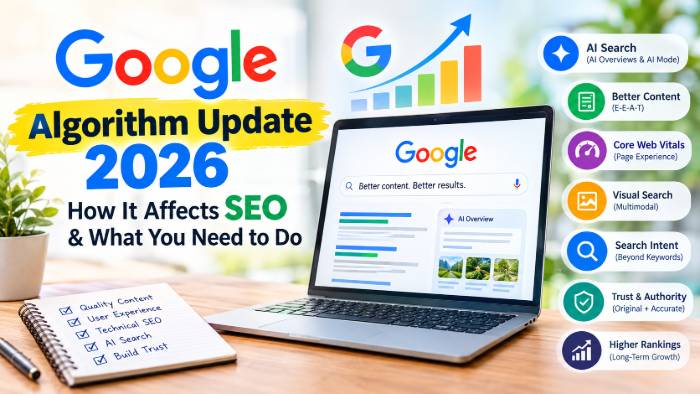
Google Search is changing faster than ever in 2026. With AI Overviews, AI Mode, multimodal search, continuous ranking improvements, and increasingly sophisticated content evaluation, traditional SEO strategies are no longer enough on their own.
Google continues to make changes to its Search systems, including smaller ongoing updates that can affect website visibility without waiting for a major core update. At the same time, Google is providing new guidance for websites that want to appear in generative AI search experiences.
So, what does this mean for businesses, bloggers, publishers, and SEO professionals?
The biggest lesson is simple: SEO in 2026 is becoming more focused on helpful, original, trustworthy content and a strong overall user experience.
Table of Contents
What Has Changed in Google SEO in 2026?
Google’s search results are increasingly designed to understand the meaning behind a query instead of simply matching keywords.
AI-powered search features can summarize information, compare sources, answer complex questions, and help users discover websites. Google has also introduced additional tools and Search Console insights to help website owners understand how their content appears in generative AI experiences.
This means ranking for a single keyword is no longer the only goal.
Websites need to become useful sources that Google can confidently understand, trust, and recommend.
1. Helpful and Original Content Matters More
One of the biggest SEO priorities in 2026 is content quality.
Google’s guidance says its systems aim to prioritize content that is helpful and provides a satisfying experience. Its quality guidance also emphasizes experience, expertise, authoritativeness, and trustworthiness, commonly referred to as E-E-A-T.
This means publishing hundreds of generic AI-generated articles is unlikely to be a strong long-term strategy.
Instead, create content that adds something valuable.
For example, instead of writing:
“10 Benefits of Digital Marketing”
create:
“10 Digital Marketing Strategies We Tested for Small Businesses in 2026”
The second topic can include real examples, results, screenshots, expert opinions, original research, and practical recommendations.
That type of content provides information that is more difficult to replace with generic content.
2. AI-Generated Content Needs Human Value
AI tools can make content creation faster, but simply generating large quantities of articles is not a sustainable SEO strategy.
Google’s quality guidance specifically points toward the importance of original effort, originality, accuracy, and satisfying the user’s purpose. Automatically generated pages with little human oversight or added value can be considered low-effort content.
AI can still be extremely useful for SEO.
You can use AI to:
- Research content ideas
- Create article outlines
- Generate topic clusters
- Improve readability
- Find FAQ opportunities
- Analyze competitors
- Create content briefs
- Identify keyword variations
However, the final content should include human expertise, unique insights, examples, data, experience, and fact-checking.
3. SEO Is Expanding Beyond Traditional Search Results
In 2026, SEO is not only about getting a blue link on Google’s results page.
Google is increasingly integrating AI-powered experiences into Search. Its 2026 guidance specifically discusses optimizing content for generative AI features while emphasizing that traditional SEO fundamentals remain important.
This creates a new opportunity often called AI SEO, AEO, or GEO.
However, website owners should not completely abandon traditional SEO.
Instead, focus on creating content that is:
- Easy for search engines to understand
- Well structured
- Factually accurate
- Original
- Helpful
- Supported by credible information
- Written for real users
Strong traditional SEO remains the foundation for visibility across modern search experiences.
4. Search Intent Is More Important Than Keyword Density
Keyword stuffing is an outdated SEO strategy.
Google is increasingly capable of understanding context and search intent. Therefore, your content should answer the actual question behind a search.
For example, someone searching for:
“best SEO tools for small business”
may want comparisons, pricing, features, pros and cons, and recommendations.
Simply repeating “best SEO tools for small business” 20 times will not satisfy that intent.
Instead, build a comprehensive article that actually helps the reader make a decision.
Use related terms naturally, answer common questions, provide examples, and organize information using clear headings.
5. User Experience and Core Web Vitals Still Matter
Content is extremely important, but technical SEO should not be ignored.
Google’s page-experience guidance recommends paying attention to factors such as Core Web Vitals, mobile usability, HTTPS, intrusive advertisements, and overall usability. Google also makes clear that there is no single “page experience signal”; multiple factors contribute to the overall experience.
In practical terms, your website should:
- Load quickly
- Work well on mobile devices
- Use HTTPS
- Have clear navigation
- Avoid intrusive pop-ups
- Make content easy to read
- Provide a good overall browsing experience
A technically strong website combined with genuinely useful content gives your SEO strategy a stronger foundation.
6. Visual and Multimodal Search Are Becoming More Important
Another important SEO development in 2026 is the growth of multimodal search.
Google introduced new Search Console reporting for web multimodal searches in September 2026. The reporting includes searches involving Google Lens, Circle to Search, image uploads, and image-based search experiences.
This means image SEO deserves more attention.
Businesses should optimize:
- Image file names
- Alt text
- Image quality
- Relevant surrounding content
- Structured data where appropriate
- Original photographs and graphics
For ecommerce, local businesses, travel websites, food websites, and visual publishers, this can create additional opportunities to attract search traffic.
7. SEO Performance Should Be Monitored More Carefully
Algorithm changes can cause rankings and traffic to fluctuate.
If your traffic drops, don’t immediately assume that you need to change everything.
First, check Google Search Console and analytics data.
Look for:
- Ranking changes
- Organic clicks
- Impressions
- Click-through rate
- Pages losing traffic
- Queries losing visibility
- Mobile versus desktop performance
- New traffic opportunities
Google has also been expanding Search Console insights for newer search experiences, helping site owners understand how their content appears across evolving Search features.
Data should guide your SEO decisions rather than assumptions.
How to Prepare Your Website for Google SEO in 2026
A strong 2026 SEO strategy should include the following checklist:
1. Create people-first content
Write for your target audience instead of writing only for search engines.
2. Add original value
Include personal experience, expert opinions, examples, research, statistics, images, videos, or original analysis.
3. Improve existing content
Update outdated information and improve pages that already receive impressions but have weak rankings.
4. Strengthen topical authority
Build useful content clusters around important subjects instead of publishing unrelated articles.
5. Improve technical SEO
Fix indexing issues, broken links, duplicate content, mobile problems, and performance issues.
6. Optimize for AI search
Structure content clearly and provide concise, trustworthy answers supported by useful details.
7. Improve visual SEO
Use original and relevant images with descriptive metadata.
8. Monitor Search Console regularly
Look for ranking changes, traffic patterns, indexing issues, and emerging search opportunities.
Final Thoughts
Google SEO in 2026 is not about finding one secret ranking factor.
It is about building a website that deserves to be discovered.
The latest direction of Google Search shows a stronger focus on useful content, originality, trust, user experience, and visibility across traditional and generative search experiences. Google also continues to make smaller ranking-system improvements, meaning SEO should be treated as an ongoing process rather than something completed once.
Businesses that rely on keyword stuffing, mass-produced low-value content, or outdated SEO tactics may struggle to maintain visibility.
On the other hand, websites that consistently publish helpful, original, accurate, experience-driven content and provide an excellent user experience can build stronger long-term search visibility.
In short, the future of SEO is not about creating more content.
It is about creating better content that people—and increasingly AI-powered search systems—can understand, trust, and find genuinely useful.
Read Also: Marketing for Non-Techies: A Complete Beginner’s Guide