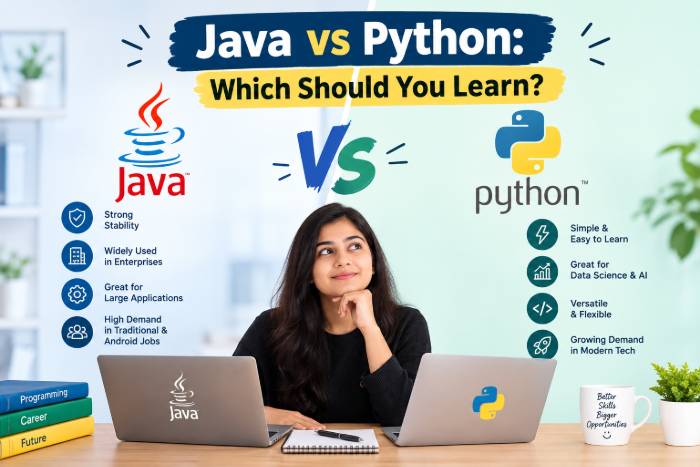
Java vs Python: Which Should You Learn?
Table of Contents
Java and Python at a Glance
If you are starting your programming journey in 2026, you have probably encountered the same question again and again: Java vs Python—which should you learn? Both languages are mature, widely used, and supported by enormous developer communities, but they solve problems in somewhat different ways. Java has a long-standing reputation in enterprise software, backend systems, Android-related development, and large-scale applications, while Python has become particularly prominent in automation, data analysis, artificial intelligence, machine learning, scientific computing, scripting, and web development. The interesting part is that neither language is simply “better” in every situation. Choosing between them is a little like choosing between two well-equipped toolboxes: the better toolbox depends on what you want to build. Current developer-survey data also shows that both remain important technologies. Stack Overflow’s 2025 Developer Survey continued to list Python among the most-used programming languages, while Java remained a significant language in professional development. The TIOBE Index also continues to track both languages prominently, although rankings fluctuate over time and should not be treated as a direct measure of job opportunities.
What Is Java?
Java is a general-purpose, class-based programming language originally developed at Sun Microsystems and released publicly in the mid-1990s. Its famous “write once, run anywhere” philosophy comes from the Java Virtual Machine, or JVM, which allows compiled Java bytecode to run across supported environments. Java’s design emphasizes strong typing, object-oriented programming, portability, performance, and maintainability. These characteristics have helped Java become deeply embedded in enterprise applications, banking systems, large backend platforms, business software, and many other environments where reliability and long-term maintainability matter. Java is also associated with an extensive ecosystem that includes frameworks such as Spring and Spring Boot, build tools such as Maven and Gradle, testing frameworks, application servers, and cloud-native development technologies. For someone interested in becoming a professional software developer, Java can therefore provide more than knowledge of one programming language: it introduces concepts such as classes, interfaces, inheritance, encapsulation, static typing, exception handling, concurrency, and software architecture. That deeper structure can initially make Java feel more demanding than Python, but it can also provide a strong foundation for understanding how large software systems are designed and maintained.
What Is Python?
Python is a high-level, general-purpose programming language known for readable syntax and a broad collection of libraries and frameworks. Guido van Rossum created Python, and its first public release appeared in 1991. One reason beginners often gravitate toward Python is that the syntax tends to resemble plain English more closely than many traditional programming languages. You can write a useful Python program with relatively little code, which makes experimentation feel fast and rewarding. Python’s ecosystem is particularly strong in areas such as artificial intelligence, machine learning, data science, automation, scripting, scientific computing, web development, and cybersecurity tooling. Libraries and frameworks including NumPy, pandas, scikit-learn, PyTorch, TensorFlow, Django, and FastAPI have helped establish Python across multiple technical fields. That versatility is one of its biggest advantages. A student can start with basic programming exercises, move into automation, build a web application, analyze datasets, and eventually explore machine learning without having to switch languages immediately. Python is not automatically the right choice for every software project, but its combination of readability, libraries, community support, and flexibility makes it an especially attractive first language for many learners.
Java vs Python: Key Differences
The biggest difference between Java and Python is not simply their syntax. Their programming models, execution approaches, type systems, ecosystems, and common professional uses create different learning and development experiences. Java is generally statically typed, meaning variables have declared or inferred types that are checked before the program runs, while Python is dynamically typed, allowing a variable to reference different kinds of objects during execution. Java programs are commonly compiled into bytecode that executes on the JVM, whereas Python implementations typically interpret or otherwise execute Python code through a runtime such as CPython. These differences affect development speed, error detection, performance characteristics, and the way developers structure applications. Java often asks you to be more explicit, which can feel verbose when you are learning, while Python allows you to move quickly from an idea to a working program. Imagine building a house: Java tends to encourage more formal blueprints and structural planning, whereas Python can feel more like working with a flexible workshop where you can prototype quickly. Neither approach is universally superior. The practical question is which environment aligns with the type of programming you want to do.
Syntax and Ease of Learning
For many beginners, Python is easier to learn initially because its syntax is relatively concise and readable. Consider a simple loop: Python can express the concept with indentation and a small number of keywords, while Java generally requires additional structural syntax, including braces and type declarations. This difference becomes important when you are learning fundamental concepts such as variables, conditions, loops, functions, and data structures because less syntax can allow you to concentrate on the programming idea itself. Java, however, teaches explicit programming concepts that become valuable when you progress into larger applications. Its static type system, object-oriented structure, and compiler feedback can help learners understand relationships between data and behavior. The learning experience therefore depends on your personality and goals. If you want quick experimentation and immediate results, Python can provide a smoother beginning. If your goal is to develop a strong foundation in structured, object-oriented software development, Java’s additional formality may be useful. The important thing is not to confuse “easier to start” with “better for everything.” A language can be beginner-friendly while still being capable of sophisticated professional development.
Performance and Speed
Java generally has an advantage over Python in raw execution performance for many CPU-intensive general-purpose workloads, although actual results depend heavily on the application, libraries, runtime, algorithms, hardware, and implementation details. Java benefits from the JVM’s mature runtime technologies, including just-in-time compilation, which can optimize frequently executed code while an application is running. Python’s standard implementation, CPython, has historically faced limitations for CPU-bound multithreaded workloads because of the Global Interpreter Lock, although Python’s ecosystem and implementation landscape continues to evolve. Performance, however, should not be the only factor used to select a language. A Python application using optimized native libraries can perform extremely well for numerical and data-processing workloads because much of the heavy computation may happen outside ordinary Python bytecode. Similarly, Java’s performance advantages matter differently in a large backend service than they do in a small automation script. In real projects, algorithm quality, architecture, database design, caching, network latency, and infrastructure can matter as much as language choice. For beginners, therefore, it is usually better to choose a language that supports the intended project rather than obsessing over benchmark numbers.
Career Opportunities
Both languages can lead to strong programming careers, but the surrounding job categories often differ. Java appears extensively in enterprise software, backend engineering, financial technology, large business applications, distributed systems, and organizations with substantial existing Java codebases. Python is heavily represented in data science, machine learning, artificial intelligence, automation, analytics, backend development, scripting, research, and testing. The exact opportunities vary by country, city, company, experience level, and specialization. In India, for example, Java continues to appear across large IT-services and enterprise-development environments, while Python has substantial demand across software development, data, cloud, automation, and AI-related roles. Job listings should be examined for the specific location and experience level you care about rather than relying on broad claims about which language is “most in demand.” A useful strategy is to search for roles you actually want—such as Java Developer, Spring Boot Developer, Python Developer, Backend Developer, Data Analyst, Data Scientist, or Machine Learning Engineer—and then examine the recurring skills in those listings. That approach gives you a much clearer picture of the market than simply comparing programming-language popularity charts.
Java vs Python for Beginners
If you have never written code before, the first language you choose can influence how quickly you experience that exciting moment when your own program actually works. Python often provides that moment quickly. You can install Python, open an interactive environment, create a few variables, write conditions and loops, and start experimenting without learning a large amount of syntax first. This low friction is valuable because programming is learned through repeated practice, not by memorizing definitions. Java takes a more structured route, and beginners may encounter classes, methods, access modifiers, data types, compilation, and project structure earlier. That can feel intimidating during the first few weeks. However, those concepts are not unnecessary obstacles; they represent ideas that professional developers use every day. The right choice therefore depends on your intended destination. If you want to explore programming, automation, AI, or data science, Python gives you an accessible entry point. If you already know you want enterprise backend development and are comfortable with a more structured learning path, Java can be an excellent first language.
Which Language Is Easier to Start With?
For most absolute beginners, Python has the gentler initial learning curve. Its readable syntax means that a learner can focus on concepts instead of spending too much time remembering punctuation and boilerplate. You can also use Python for small practical projects very early: renaming files, processing spreadsheets, consuming an API, analyzing a CSV file, creating a basic web application, or experimenting with an AI library. Those quick wins can make learning addictive in a positive way. Java requires more setup and introduces more concepts around program structure, but this is also part of its educational value. A student learning Java can develop a solid understanding of object-oriented programming and strongly typed application design from the beginning. Think of Python as a bicycle with fewer controls and Java as a vehicle that introduces more controls from the start. The bicycle may be easier to ride on day one, but both can take you surprisingly far when you learn how to use them properly.
Learning Curve and Practice
Regardless of your choice, consistent practice matters more than the language itself. Spending three months watching programming tutorials without writing code will usually produce less progress than spending one hour each day building small programs. Start with variables, operators, conditions, loops, functions, collections, error handling, and file operations. Then build something that solves a real problem. Python learners might create a file organizer, expense tracker, weather application, or simple data dashboard. Java learners might create a student management system, banking application, library management system, or REST API. Once you have built several small applications, move into databases, Git, APIs, testing, and debugging. Programming becomes much easier when concepts are connected to real problems. Instead of asking, “How do I memorize this syntax?” ask, “What problem can I solve with this concept?” That shift turns programming from a textbook subject into a practical skill.
Java vs Python for Web Development
Both Java and Python are capable web-development languages, although their ecosystems have different traditions. Java’s Spring ecosystem is particularly important for backend and enterprise development, with Spring Boot making it easier to build production-ready applications and REST APIs. Java’s strong typing and mature tooling can be useful in large development teams where multiple developers work on the same codebase for years. Python has several popular web frameworks, especially Django and Flask, while FastAPI has become an important choice for API development. Python’s concise syntax can make prototyping and application development feel fast. A startup building a prototype might appreciate Python’s speed of development, while a large organization with established Java infrastructure may have strong reasons to use Java. Cloud deployment, containerization, microservices, databases, authentication, testing, and observability are also more important to professional backend development than the programming language alone. If web development is your goal, choose based on the type of companies and applications you want to build, then learn the framework associated with that ecosystem.
Java Frameworks
The Java ecosystem has a particularly strong position in enterprise backend development. Spring Boot is one of the most important technologies to learn if you are targeting modern Java backend roles. It simplifies configuration and helps developers build REST APIs, web applications, microservices, and integrations. Around Spring Boot, developers commonly encounter Spring MVC, Spring Data JPA, Spring Security, Hibernate, Maven or Gradle, JUnit, Docker, relational databases, and cloud services. Learning Java without learning its professional ecosystem is similar to learning the alphabet without learning how to write sentences. For job preparation, focus on Java fundamentals first and then gradually move into object-oriented programming, collections, exception handling, streams, multithreading, SQL, REST APIs, Spring Boot, Git, testing, and deployment. This path is particularly relevant for people targeting backend developer positions in enterprise environments.
Python Frameworks
Python gives web developers several options depending on the type of application. Django provides a comprehensive framework with built-in features for routing, database interaction, authentication, forms, and application structure. Flask is lighter and often used when developers want more flexibility and control over architecture. FastAPI is designed around modern API development and uses Python type hints extensively. The wider Python ecosystem also makes it easy to connect web applications with data-processing, automation, and machine-learning workflows. This combination is one reason Python is attractive for projects where the backend needs to interact with analytical or AI functionality. A developer might create an API using FastAPI, process data with pandas, run a machine-learning model, and return the result to a web or mobile client. That kind of workflow demonstrates Python’s strength: the language can act as a bridge between different technical disciplines.
Java vs Python for AI, Data Science and Automation
This is an area where Python has become especially prominent. Libraries such as NumPy, pandas, scikit-learn, PyTorch, and TensorFlow provide tools for numerical computing, data manipulation, machine learning, and deep learning. Python’s syntax also makes experimental code relatively concise, which is useful when researchers and engineers need to test multiple ideas quickly. A data scientist might import a dataset, clean it, visualize patterns, train a model, evaluate the results, and iterate—all within a Python-centered workflow. Java is also capable of machine learning and data engineering, and JVM-based technologies are used in production systems, but Python is deeply embedded in the modern AI and data-science ecosystem. If your specific career goal is machine learning engineer, data scientist, AI developer, data analyst, or automation engineer, Python is therefore highly relevant. It is not magic, though. Learning Python alone will not make someone an AI professional. You also need mathematics appropriate to your specialization, statistics, algorithms, data structures, model evaluation, databases, APIs, deployment, and responsible use of AI systems.
Python’s AI and Data Ecosystem
Python’s biggest advantage in AI is arguably the ecosystem rather than the language syntax itself. A programming language becomes powerful when thousands of developers build reliable tools around it. With Python, learners can move from basic programming to NumPy for numerical arrays, pandas for data manipulation, Matplotlib for visualization, scikit-learn for traditional machine learning, and PyTorch or TensorFlow for deep learning. The ecosystem also connects easily with notebooks, cloud platforms, databases, APIs, and modern AI services. This creates a relatively continuous learning path. Someone can start by analyzing sales data and later build a predictive model or integrate a language model into an application. Java has libraries and frameworks for many of these tasks as well, but Python’s concentration of AI and data tooling makes it especially practical for newcomers entering these fields. If artificial intelligence is the destination, Python is generally the more direct road because so much educational material, research code, experimentation, and tooling is built around it.
Java vs Python for Enterprise Development
Enterprise software has different priorities from a weekend coding project. Large organizations need systems that can be maintained by teams, tested systematically, monitored in production, secured properly, and integrated with existing infrastructure. Java has a long history in this environment, particularly in banking, insurance, telecommunications, retail, government systems, and large business applications. Its strong typing, mature tooling, JVM ecosystem, and extensive enterprise frameworks make it suitable for applications where maintainability and predictable structure are important. Python can also be used successfully in enterprise environments, particularly for APIs, automation, data platforms, internal tools, and AI-related applications. The distinction is therefore not “Java for serious software and Python for simple software”—that would be inaccurate. Modern engineering teams choose technologies based on architecture, existing systems, team expertise, performance requirements, deployment constraints, and business needs. If your career goal involves enterprise Java development, learning Spring Boot, SQL, REST, Git, testing, Docker, and cloud concepts alongside core Java will be much more valuable than learning Java syntax alone.
Java vs Python: Job Market and Career Growth
A programming language can open a door, but your broader technical skill set determines what happens after you enter. Employers rarely want someone who only knows syntax. A Java developer may need Java, Spring Boot, SQL, REST APIs, Git, testing, Docker, cloud fundamentals, and software-development practices. A Python developer might need Python, Django or FastAPI, SQL, APIs, Git, testing, cloud services, and possibly data or AI technologies. Career growth also depends on communication, problem-solving, system design, debugging, teamwork, and the ability to understand business requirements. This is particularly important for people changing careers because a portfolio of meaningful projects can demonstrate practical ability. Instead of creating ten tiny tutorial projects, build two or three applications that solve realistic problems. Explain your architecture, database design, API structure, testing approach, challenges, and lessons learned. Whether you choose Java or Python, that evidence can make your learning journey much more credible to employers.
Java vs Python Salary Considerations
It is tempting to search for a single answer to “Does Java or Python pay more?” but salary comparisons are unreliable without specifying country, city, job title, experience, industry, company size, and specialization. A senior Java backend engineer and an entry-level Python automation developer are not directly comparable simply because both use programming languages. Likewise, a machine-learning engineer using Python may have a very different compensation profile from a Python web developer. Skills surrounding the language often matter substantially. Cloud engineering, system design, distributed systems, AI/ML, cybersecurity, DevOps, databases, and leadership can all affect career progression. Instead of choosing a language solely based on salary claims from generic websites, examine actual job descriptions in the market where you want to work. Look for repeated requirements, identify the roles you can realistically target within six to twelve months, and build your learning plan around those requirements. The goal should be employable capability, not merely knowledge of a programming language.
Java vs Python for Students and Career Changers
For students and career changers, the decision can be especially important because learning time is limited. Python can be attractive if you want to move quickly into automation, data, AI, scripting, or general programming. Java can be attractive if you are specifically targeting backend development, enterprise applications, or organizations that rely heavily on the JVM ecosystem. If you are coming from a non-technical background, Python’s readable syntax may reduce the initial intimidation factor. If you already have experience with structured problem-solving and want to pursue enterprise software, Java may fit naturally. Either way, don’t try to learn five programming languages simultaneously. Pick one, learn it properly, build projects, understand Git and databases, and then expand. Once you understand programming fundamentals, learning a second language becomes dramatically easier because concepts such as variables, loops, functions, data structures, APIs, debugging, and object-oriented design transfer between languages.
Java vs Python: Pros and Cons
| Factor | Java | Python |
| Beginner friendliness | Moderate | High |
| Syntax | More verbose and structured | Concise and readable |
| Typing | Generally statically typed | Dynamically typed |
| Performance | Generally strong for many application workloads | Often slower for pure Python CPU-bound code |
| AI/ML ecosystem | Good | Excellent and widely adopted |
| Data science | Good | Excellent |
| Enterprise backend | Very strong | Strong |
| Automation | Good | Excellent |
| Web development | Strong with Spring | Strong with Django, Flask, FastAPI |
| Mobile history | Strong historical association with Android | Limited |
| Learning resources | Extensive | Extensive |
| Ecosystem maturity | Very mature | Very mature |
| Best fit depends on | Enterprise/backend/software engineering goals | AI/data/automation and broad rapid development goals |
The table shows why a universal winner does not exist. Java and Python overlap considerably, but their centers of gravity are different. Java tends to be particularly compelling for structured backend and enterprise development, while Python has exceptional momentum in AI, data, automation, and rapid development. The correct decision becomes much easier when you define your target role first. If your goal is “I want to become a programmer,” either can work. If your goal is “I want to become a machine-learning engineer,” Python becomes highly relevant. If your goal is “I want to become a Java Spring Boot backend developer,” Java is the obvious language to prioritize.
Java vs Python: Which Should You Learn?
The answer depends on what you want to build and what career you want to pursue. Choose Python if you are interested in artificial intelligence, machine learning, data science, automation, scripting, scientific computing, or a relatively approachable first programming language. Choose Java if you are focused on enterprise software, backend development, Spring Boot, large-scale business applications, or a career path where Java is a core requirement. If you are completely undecided, Python can provide a gentle introduction to programming, while Java can give you an early introduction to more formal object-oriented and strongly typed development. Neither choice locks you into one career forever. Once you understand programming fundamentals, you can learn the other language much faster. The smartest decision is therefore not about following a popularity chart; it is about matching your first language to the problems you want to solve.
How to Choose the Right Language
Before committing to a learning roadmap, answer five simple questions. What job do you want? What kind of software do you want to build? Do you enjoy data and AI? Are you targeting enterprise backend development? How much time can you consistently dedicate to practice? Your answers can make the decision surprisingly straightforward. If you say “I want to build AI applications,” Python should be central to your learning plan. If you say “I want to become a Spring Boot backend developer,” focus on Java. If you say “I don’t know yet,” start with Python or Java based on the type of beginner projects that excite you most, then reassess after several weeks. Don’t spend months comparing languages without writing code. The best way to discover what you like is to build something. Your first programming language is not a tattoo; it is a tool you are using to learn how software works.
Can You Learn Both Java and Python?
Absolutely. In fact, learning both can eventually be valuable, especially for developers working across different types of systems. However, learning both at the same time as a complete beginner can create unnecessary confusion. Imagine trying to learn two spoken languages simultaneously while still learning what a sentence is. You may remember fragments of both without developing confidence in either. A better approach is sequential learning. Spend several months becoming comfortable with one language, build real projects, learn Git and SQL, understand APIs and debugging, and then introduce the second language. Once you understand variables, loops, functions, classes, collections, exceptions, modules, testing, and software architecture, moving between Java and Python becomes much easier. You start seeing the similarities underneath the syntax. Java may use ArrayList where Python uses a list, and Java classes have more explicit structure, but the underlying programming concepts are transferable.
A Practical Learning Roadmap
A practical beginner roadmap should move from syntax to concepts, concepts to projects, and projects to employability. During the first stage, learn variables, operators, conditions, loops, functions, collections, and basic error handling. Then learn object-oriented programming, file handling, modules, debugging, and testing. After that, introduce Git and GitHub, SQL, databases, HTTP, REST APIs, JSON, and basic software-development practices. Your next stage should depend on your chosen career. Java learners can move into Spring Boot, JPA/Hibernate, REST APIs, security, testing, Docker, and cloud fundamentals. Python learners can choose Django or FastAPI for backend development, or pandas, NumPy, scikit-learn, and machine-learning concepts for data-focused careers. Build at least two serious projects and publish the code with clear documentation. A portfolio is your workshop window: it allows employers and other developers to see what you can actually make.
Common Mistakes Beginners Make
One of the biggest mistakes is spending too much time comparing languages and too little time programming. Beginners can become trapped in endless discussions about Java versus Python, the “best” framework, the highest salary, or the latest technology. Meanwhile, they have written very little code. Another common mistake is tutorial dependency—watching someone else build an application can create the illusion of understanding without developing independent problem-solving ability. Copying code is useful during learning, but eventually you need to close the tutorial and build something yourself. Beginners also frequently ignore debugging, Git, SQL, APIs, and testing because these subjects seem less exciting than programming syntax. In professional development, however, these skills are fundamental. Don’t aim to know everything before building your first project. Build, break, debug, improve, document, and repeat. That cycle is where real programming ability develops.
Conclusion
Java vs Python is not really a battle between two programming languages; it is a choice between two powerful ecosystems that support different kinds of work particularly well. Python offers approachable syntax and an exceptionally strong ecosystem for AI, machine learning, data science, automation, scripting, and rapid development. Java provides a structured programming environment and a mature ecosystem that is deeply established in enterprise software, backend systems, and large-scale applications. Both languages have extensive communities, learning resources, frameworks, libraries, and professional opportunities. The right choice depends on your destination rather than a universal ranking. If your goal is AI, data, or automation, Python is a natural starting point; if your goal is enterprise backend development and Spring Boot, Java is a natural fit. Whichever you choose, focus on fundamentals, build real projects, learn complementary technologies, and practice consistently. A programming language is only the vehicle—the real career advantage comes from learning how to solve problems with it.
FAQs
1. Is Java harder to learn than Python?
Java often has a steeper initial learning curve because it introduces more explicit syntax, types, and program structure. Python generally allows beginners to write useful programs with less code. However, Java’s structure can help learners develop strong foundations in object-oriented and enterprise programming. Difficulty ultimately depends on your background, learning style, and goals.
2. Should I learn Python or Java first?
If you are completely new to programming, Python can be an approachable first choice because of its readable syntax. If you already know that you want to pursue Java backend development or Spring Boot development, starting with Java can make more sense. Your target career should be the main factor.
3. Is Python better than Java for AI?
Python is widely used in modern AI and machine learning because of its extensive ecosystem, including tools such as NumPy, pandas, scikit-learn, PyTorch, and TensorFlow. Java can also be used for AI-related applications, but Python is particularly prominent for experimentation, data preparation, machine learning, and research workflows.
4. Can I get a job after learning only Java or Python?
Knowing the language itself is usually not enough for most professional software-development roles. You should also learn relevant frameworks, databases, Git, APIs, testing, debugging, and software-development practices. The exact skill combination depends on the role you want.
5. Can I learn Java and Python together?
You can, but beginners generally benefit from becoming comfortable with one language first. Once you understand programming fundamentals, learning the second language becomes easier because many concepts transfer. A sequential approach can reduce confusion and help you build stronger practical skills.
Read Also: Why Java Is Still Dominating Enterprise Development in 2026?