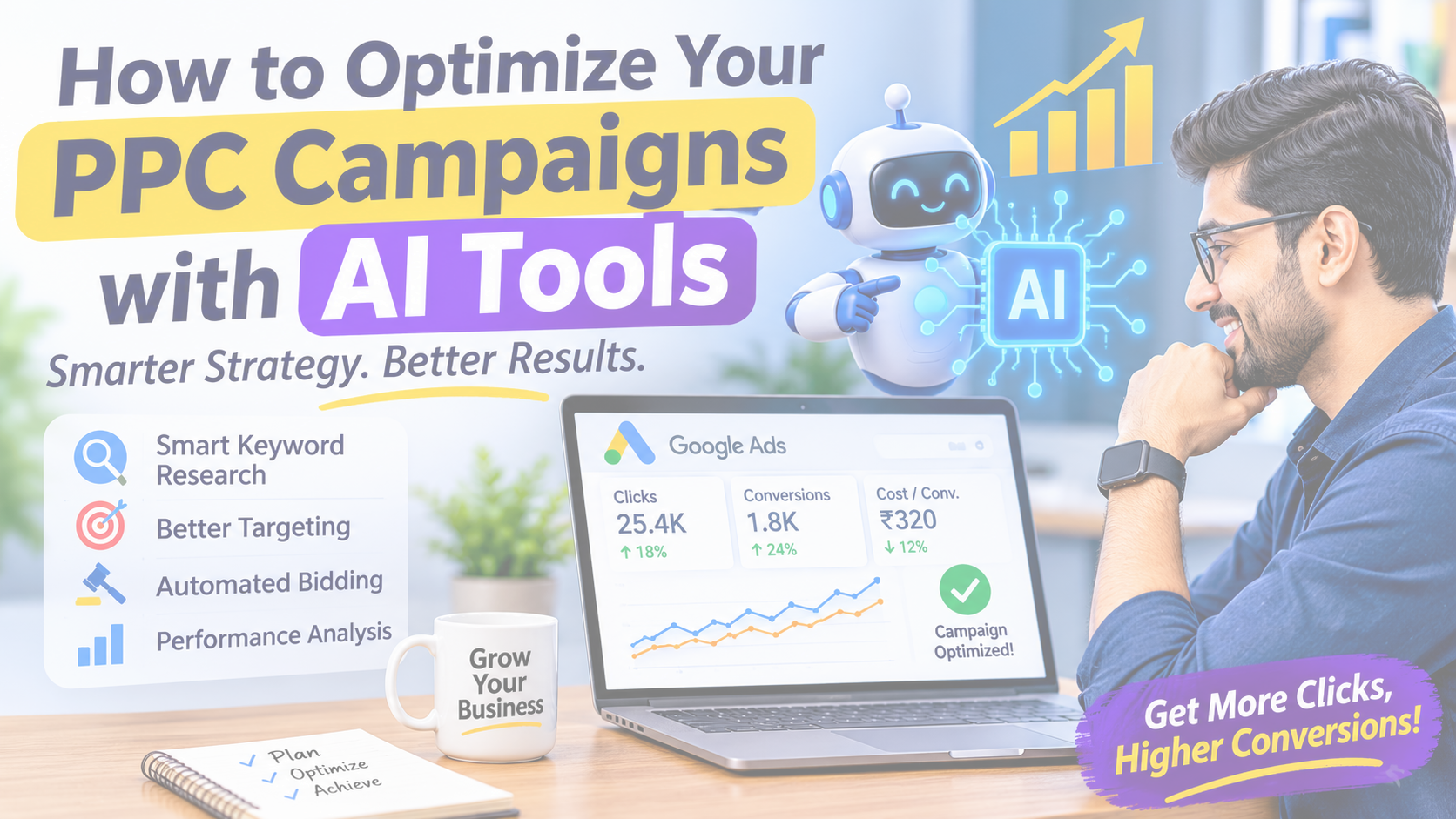
How to Optimize Your PPC Campaigns with AI Tools?
Pay-per-click (PPC) advertising is a powerful way for businesses to reach their target audience, get quality leads, and boost online sales. But running a successful PPC campaign takes more than just making ads and setting a budget. You need to keep analyzing data, researching keywords, adjusting bids, improving ad content, and tracking results. Artificial Intelligence (AI) is changing how marketers handle paid ads by making these tasks quicker and more effective. If you’re a business owner, marketer, or learning about digital marketing courses in Pune, knowing how to use AI tools for PPC can help you stay ahead in today’s digital world.
Table of Contents
1. Understanding PPC Advertising in the AI Era
PPC, or Pay-Per-Click advertising, is an online advertising model where advertisers pay whenever someone clicks on their advertisement. Platforms such as Google Ads, Meta Ads, LinkedIn Ads, and Microsoft Advertising allow businesses to promote their products and services to specific audiences.
In the past, marketers did most PPC tasks by hand, like researching keywords, adjusting bids, choosing audiences, writing ads, and checking performance. These jobs took a lot of time, skill, and constant attention.
With AI-powered advertising, marketers can automate routine tasks, review large amounts of campaign data, spot customer behavior trends, and make data-driven decisions.
For example, Google’s AI bidding can automatically change bids depending on how likely a conversion is. Similarly, generative AI tools help marketers create different versions of ad headlines, descriptions, and promotional content.
When you combine human creativity with AI, your ads can perform better while helping you avoid wasting money.
2. Why AI Is Important for PPC Campaign Optimization
AI is changing PPC advertising by helping marketers make quicker, smarter decisions.
Here are some major benefits of using AI in PPC campaigns.
- Better targeting: AI analyses user behavior, search intent, interests, demographics, and previous interactions to help advertisers reach relevant audiences.
- Automated bidding: AI-powered bidding strategies adjust bids based on campaign objectives, competition, and conversion potential.
- Improved keyword research: AI tools identify relevant keywords, search trends, and potential opportunities based on available data.
- Faster ad creation: Generative AI helps marketers develop headlines, descriptions, and creative variations.
- Budget optimization: AI can help identify campaigns, ad groups, and keywords that consume budget without generating sufficient results.
- Performance prediction: Predictive analytics can help marketers identify trends and estimate possible campaign outcomes.
- Continuous optimization: AI-powered advertising systems can process campaign signals and adjust strategies automatically within their available settings.
These benefits show why AI is now a key part of managing PPC campaigns.
3. Top AI Tools for Optimizing PPC Campaigns
Many AI tools can help marketers get better results from paid ads. The best tool for you depends on your campaign goals, the platforms you use, and your business needs.
1. Google Ads AI Features
Google Ads provides several AI-powered features that help advertisers improve campaign performance.
Important features include:
- Smart Bidding for automated bid optimization.
- Performance Max campaigns for reaching customers across Google’s advertising channels.
- Responsive Search Ads for testing combinations of headlines and descriptions.
- AI-powered audience signals and targeting capabilities.
- Automated recommendations for campaign improvements.
For example, if you run an online clothing store and want more sales, you don’t have to adjust every keyword bid by hand. You can use a Smart Bidding strategy like Target ROAS, as long as you have enough conversion data.
2. ChatGPT
ChatGPT can support PPC campaign planning, research, copywriting, and analysis.
You can use ChatGPT for:
- Generating Google Ads headlines.
- Writing compelling ad descriptions.
- Creating keyword grouping ideas.
- Developing negative keyword suggestions.
- Writing different advertising messages for different audiences.
- Analyzing exported campaign reports.
- Creating A/B testing ideas.
Example prompt:
“Generate 15 Google Search Ads headlines for digital marketing classes in Pune. Focus on practical training, experienced trainers, career opportunities, and course benefits. Keep headlines within Google’s applicable character limits.”
ChatGPT can generate many creative ideas that marketers can review and test.
3. SEMrush
SEMrush offers advertising research and keyword analysis features.
Marketers can use it to:
- Research competitor advertising strategies.
- Discover paid search keyword opportunities.
- Analyze competitor ad copy.
- Identify keyword trends.
- Explore advertising opportunities.
For example, if a competitor is using Google Ads for a certain service, advertising research can show you what keywords they use and help you find chances to improve your own campaigns.
4. Canva AI
Canva provides AI-assisted design features that help marketers create advertising creatives.
You can use Canva AI to:
- Create social media advertisements.
- Design promotional banners.
- Generate creative concepts.
- Resize advertisements for different platforms.
- Develop multiple visual variations.
Strong visuals can help your ads grab attention and communicate your message clearly.
5. Microsoft Copilot
Microsoft Copilot can assist with research, spreadsheet analysis, reporting, and marketing documentation.
For PPC professionals, it can help sort campaign data, summarise reports, and flag areas that need a closer look.
4. Conduct Smarter Keyword Research Using AI
Keyword research is a key part of managing PPC campaigns. If you pick the wrong keywords, you might get clicks that don’t matter, waste your ad budget, and see fewer conversions. AI tools can help you figure out what people are really searching for and find the right keywords. For example, if you’re promoting digital marketing courses in Pune, think about what students want to know, like course details, hands-on training, fees, certificates, and job options. AI can help group these searches and suggest ad messages that match what users are looking for.
How to use AI for PPC keyword research
Step 1: Identify your business offerings
Start by listing your main products or services. For example, a digital marketing institute may offer SEO training, Google Ads training, social media marketing, and AI-powered marketing courses.
Step 2: Generate keyword ideas
Use ChatGPT, Google Keyword Planner, and other keyword research platforms to discover relevant search terms.
Step 3: Understand search intent
Divide keywords into different categories:
| Search intent | Example |
| Informational | What is PPC advertising? |
| Commercial | Best Google Ads training |
| Transactional | Enroll in Google Ads course |
| Navigational | Institute website name |
Step 4: Identify negative keywords
Negative keywords prevent advertisements from appearing for irrelevant searches.
For example, if you provide paid professional training, you might exclude searches such as free PDF, free download, or unrelated job searches, depending on your campaign objectives.
Step 5: Group keywords into ad groups
Organize similar keywords into tightly related groups. This helps you create more relevant ads and landing pages.
Keep in mind that AI keyword ideas are just a starting point. Always check search volume, competition, costs, and relevance with keyword research tools.
5. Use AI for Better PPC Ad Copywriting
Your advertising copy plays a significant role in attracting potential customers.
Even if you reach the right people, weak headlines and descriptions can make your ads less engaging.
AI-powered writing tools help marketers generate multiple ad copy variations quickly.
Important elements of effective PPC ad copy
- Attractive headlines.
- Clear value propositions.
- Relevant keywords.
- Strong calls to action.
- Unique selling points.
- Customer-focused benefits.
Example of traditional ad copy:
“Join our digital marketing training program. Contact us today.”
AI-assisted ad copy:
“Learn Practical Digital Marketing Skills. Explore SEO, Google Ads, Social Media Marketing, and AI Tools. Enquire Today!”
The second example clearly highlights benefits and gives people a stronger reason to click.
AI prompt for PPC ad copy
You can use the following prompt in ChatGPT:
“Act as a Google Ads specialist. Create 15 engaging headlines and 4 descriptions for a professional training institute. Focus on practical learning, expert guidance, industry-relevant skills, and career development. Follow the applicable Google Ads character limits. Avoid misleading claims.
Once you have the copy, check each headline and description before you publish them.
6. Optimize Your PPC Bidding Strategies with AI
Bidding determines how much you are willing to pay for advertising opportunities.
With manual bidding, marketers have to check results and change bids often. Automated bidding with AI can look at many signals and adjust bids to match your campaign goals.
Google Ads offers several automated bidding strategies.
| Bidding strategy | Main objective |
| Maximize Clicks | Generate more website clicks within the budget |
| Maximize Conversions | Generate more conversions |
| Target CPA | Achieve conversions around a target acquisition cost |
| Target ROAS | Optimize for a desired return on ad spend |
| Maximize Conversion Value | Generate the highest possible conversion value within budget |
Practical example
Imagine an online business has a monthly advertising budget of ₹30,000.
The business wants to generate qualified leads through Google Search Ads.
Instead of manually adjusting bids every day, the advertiser can test an appropriate automated bidding strategy focused on conversions.
The advertiser should monitor:
- Cost per conversion.
- Conversion rate.
- Total leads generated.
- Lead quality.
- Search terms.
- Budget utilisation.
Automated bidding doesn’t always mean you’ll spend less. It works best when you have good conversion tracking, the right campaign settings, and enough data.
7. Improve Audience Targeting with AI
Reaching the right audience is key to making your PPC ads work well.
AI helps marketers analyze customer data and identify which groups are most likely to interact with ads.
For example, an institute offering professional training may target:
- College students.
- Fresh graduates.
- Working professionals.
- Business owners.
- Entrepreneurs.
- Individuals interested in career development.
AI features in advertising can spot audience signals and improve how your ads are delivered based on results.
Audience targeting techniques
- Remarketing: Reach people who previously visited your website or interacted with your advertisements, subject to applicable privacy and consent requirements.
- Customer matching: Use eligible first-party customer data to reach relevant existing audiences where the advertising platform permits it.
- Lookalike audiences: Use similar-audience features where available to discover potential customers who resemble existing customers.
- Interest-based targeting: Reach people based on relevant interests and behaviors, depending on the advertising platform.
- Geographic targeting: Focus your advertising on specific cities, locations, or service areas.
AI can help you pick better audiences, but you should always check if your traffic is relevant and bringing real business results.
8. Create Better PPC Landing Pages Using AI
Getting people to your website is just one step in PPC. Your landing page also needs to persuade visitors to take action.
If your landing page isn’t well designed, you could waste ad money even if your ads are doing well.
AI tools can help improve your landing page content, layout, and user experience.
Important landing page elements
- Clear and attractive headline.
- Relevant information about the advertised service.
- Strong call-to-action button.
- Contact form.
- Customer testimonials.
- Benefits and features.
- Mobile-friendly design.
- Fast loading speed.
For example, if your advertisement promotes a professional training program, the landing page should provide relevant course information, curriculum details, training format, trainer details, and an easy way to ask questions.
Reviewing your campaign results is key to knowing whether your ad spend is paying off.
AI tools can help you review campaign reports and spot any unusual changes in performance.
Some important PPC metrics include:
| Metric | Meaning |
| CTR | Percentage of impressions that generate clicks |
| CPC | Average cost per click |
| CPA | Average cost per acquisition |
| Conversion Rate | Percentage of clicks resulting in conversions |
| ROAS | Revenue generated relative to advertising spend |
| Impressions | Number of times advertisements are displayed |
| Quality Score | Google’s diagnostic measure of keyword, ad, and landing page relevance |
Example of AI-powered campaign analysis
Suppose your campaign generates the following results:
- Impressions: 50,000
- Clicks: 2,500
- Advertising spend: ₹25,000
- Conversions: 100
Your campaign metrics would be:
CTR:
2,500 ÷ 50,000 × 100 = 5%
Average CPC:
₹25,000 ÷ 2,500 = ₹10
Conversion Rate:
100 ÷ 2,500 × 100 = 4%
Cost Per Conversion:
₹25,000 ÷ 100 = ₹250
These calculations make it easier for marketers to see how their campaigns are doing.
You can export Google Ads reports and use AI tools to summarise results, spot trends, and identify areas that need more attention.
But always double-check AI calculations and suggestions with your original campaign data.
10. Implement A/B Testing with AI
A/B testing is a technique used to comA/B testing means comparing different versions of your ads to see which one works best. Marketers can use actual campaign results to make decisions.
For example, you can test:
Headline A: Learn Digital Marketing with Practical Training.
Headline B: Build Your Marketing Skills with Industry Experts.
Similarly, you can test:
- Different descriptions.
- Different calls to action.
- Different landing page headlines.
- Different promotional offers.
- Different creative designs.
AI can come up with lots of testing ideas and help you look at the results.
However, make sure your tests are well planned. Change only important things, give enough time and data, and don’t decide based on too little information—mistakes to Avoid When Using AI in PPC Campaigns.
Although AI has many benefits, marketers shouldn’t rely only on automation—here are common mistakes to avoid.
- Accepting AI-generated content without checking: AI may generate inaccurate information, exaggerated claims, or irrelevant advertising messages.
- Ignoring conversion tracking: Without reliable tracking, automated bidding may optimize for incorrect or incomplete signals.
- Targeting too many keywords: Adding irrelevant keywords can increase advertising costs without improving lead quality.
- Ignoring negative keywords: Regular search-term analysis is necessary to identify unwanted traffic.
- Making frequent campaign changes: Constant changes can make performance evaluation difficult and disrupt the learning process of automated bidding strategies.
- Ignoring landing page experience: Good advertisements cannot compensate for poor website usability or irrelevant landing page content.
- Depending entirely on AI recommendations: Human expertise is necessary to evaluate business objectives, customer needs, brand positioning, and campaign quality.
The most effective results come from using AI automation along with human oversight.f AI in PPC Advertising
The future of PPC advertising will become increasingly connected to AI, automation, predictive analytics, and personalized customer experiences. Important trends marketers should understand.
AI-powered campaign automation: Advertising platforms will continue improving automated bidding, targeting, and creative optimization.
Generative AI for advertising: Marketers will increasingly use AI to develop advertising headlines, descriptions, images, and creative concepts.
Predictive analytics: AI will help businesses identify potential customer behavior patterns and forecast campaign performance.
Conversational advertising experiences: AI-powered assistants and conversational interfaces may create new ways for customers to discover products and services.
Personalized advertising: Businesses will increasingly use relevant customer signals to deliver more meaningful advertising experiences.
Privacy-focused marketing: First-party data, consent management, and privacy-compliant measurement will become increasingly important.
Marketers who know both the basics of PPC and new AI tools will be ready for changes in the advertising world. Running PPC campaigns with AI tools is no longer just an advanced marketing technique. It is becoming an important part of modern digital advertising. From keyword research and ad copywriting to automated bidding, audience targeting, landing page optimization, and campaign reporting, AI can simplify several marketing activities and support better decision-making.
However, successfuBut to run a successful PPC campaign, you still need good planning, accurate tracking, the right messages, ongoing testing, and human know-how. Think of AI as a helpful tool, not a full replacement for marketing experts. Whether you’re a student, working professional, entrepreneur, or business owner, learning how to use AI tools for paid advertising can help you develop valuable, industry-relevant skills. Start experimenting with tools such as Google Ads, ChatGPT, SEMrush, and Canva, analyze your results, and continuously improve your advertising strategies.
The future of PPC: The future of PPC will belong to marketers who mix creativity, analysis, and AI to get real business results.
Also Read: Performance Marketing in India: A Complete Guide