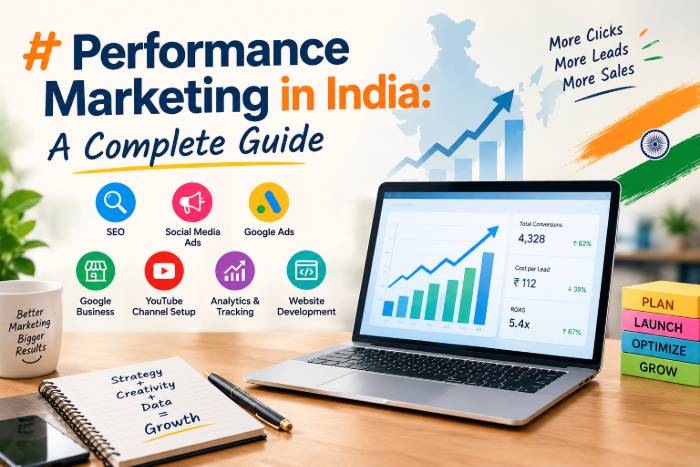
Performance Marketing in India: A Complete Guide
Table of Contents
What Is Performance Marketing?
Performance marketing is a digital marketing strategy in which businesses focus on measurable results, such as website traffic, leads, app installations, sales, and customer enquiries. Unlike traditional advertising, where companies often pay to display advertisements without knowing exactly how many people will respond, performance marketing emphasizes tracking campaign results and optimizing advertising budgets based on performance.
For example, imagine you own a digital marketing institute in Pune. You want to attract students for your digital marketing courses. You can run Google Ads targeting people searching for digital marketing classes in Pune or Meta Ads targeting students and working professionals. By tracking clicks, enquiries, demo bookings, and admissions, you can identify which campaigns generate the best results.
The biggest advantage is accountability. You can measure how much you spend to acquire a lead or customer and make informed decisions about your next marketing campaign. However, successful performance marketing requires the right audience targeting, compelling advertisements, effective landing pages, and regular optimization.
Why Is Performance Marketing Growing in India?
India’s expanding digital ecosystem has created significant opportunities for businesses to reach customers online. Consumers increasingly use search engines, social media platforms, mobile applications, and e-commerce websites to discover products and services. This behavior allows businesses of different sizes to promote their offerings to relevant audiences without depending entirely on traditional advertising channels.
From local coaching institutes and real estate companies to online retailers and technology startups, organizations can use performance marketing to generate measurable business outcomes. A local service provider can target customers within a particular city, while an e-commerce brand can advertise products to shoppers across multiple states.
The Role of Digital India and Online Shopping
Affordable internet access, smartphone adoption, digital payments, and online shopping have changed how Indian consumers discover and purchase products. Businesses can now connect with potential customers at different stages of their buying journey, from researching a product to completing a purchase.
For instance, a customer searching for pest control services in Pune may see a Google advertisement, visit a service provider’s website, compare reviews, and submit an enquiry. A well-planned performance marketing campaign can help the business reach that customer when the service is relevant to their needs.
Key Types of Performance Marketing
1. Search Engine Advertising
Search engine advertising allows businesses to display paid advertisements when people search for relevant keywords. Google Ads is one of the major platforms used for this purpose.
For example, a training institute can target searches such as “Salesforce training in Pune” or “digital marketing course in Pune.” These keywords can help businesses reach people who are actively exploring a service.
Campaign performance can be measured through impressions, clicks, conversion rates, cost per lead, and return on advertising spend. Keyword selection, ad copy, landing page quality, and bidding strategies all influence campaign outcomes.
2. Social Media Advertising
Social media advertising uses platforms such as Facebook, Instagram, and LinkedIn to reach audiences based on available targeting options, interests, professional attributes, and online behavior.
Instagram and Facebook can be useful for promoting educational courses, lifestyle products, local services, and consumer brands. LinkedIn can be valuable for B2B companies, professional training providers, and businesses targeting decision-makers.
Successful campaigns combine engaging creatives, clear messaging, relevant audience targeting, and a strong call to action. Businesses should test different advertisements rather than assume that one creative will work for every audience.
3. Affiliate and Influencer Marketing
Affiliate marketing allows partners to earn a commission when their promotional activities generate qualifying sales or other agreed-upon outcomes. Businesses can track referrals using unique links, promotional codes, or affiliate tracking systems.
Influencer marketing involves collaborating with creators who have audiences relevant to a brand. Depending on the agreement, payment may be based on a fixed fee, tracked conversions, or a combination of compensation models.
For performance-focused campaigns, businesses should establish clear objectives, tracking methods, attribution rules, and reporting expectations before launching a partnership.
How Does Performance Marketing Work?
Performance marketing follows a structured process that connects advertising activity with business goals.
First, define the objective. Decide whether the campaign should generate leads, increase online sales, attract demo bookings, or encourage app installations. Next, identify the target audience and select the appropriate advertising platform.
Create advertisements that communicate a clear benefit and direct users to a relevant landing page. Set up conversion tracking so you can measure meaningful actions rather than relying only on clicks or impressions.
Once the campaign is running, analyze the results and identify opportunities for improvement. You might adjust the targeting, revise the creative, improve the landing page, or allocate more budget to campaigns that produce profitable results.
Benefits of Performance Marketing for Indian Businesses
Performance marketing offers several advantages for businesses looking to improve their digital advertising efforts.
- Measurable results: Track clicks, enquiries, sales, and other defined conversion events.
- Budget flexibility: Start with a manageable budget and increase spending as performance improves.
- Audience targeting: Reach relevant customers based on platform targeting capabilities and campaign objectives.
- Faster optimization: Identify underperforming advertisements and test improvements.
- Scalability: Expand successful campaigns when additional spending can generate worthwhile returns.
Consider a coaching institute spending ₹20,000 on advertisements and generating 100 enquiries. Its advertising cost per lead is ₹200. If 10 of those enquiries become paying students, the advertising cost per admission is ₹2,000.
These figures are illustrative, not industry benchmarks. The actual profitability depends on course fees, conversion rates, operating costs, and student lifetime value. The lesson is simple: measure business outcomes, not just advertising clicks.
Performance Marketing Platforms in India
Different advertising platforms serve different marketing objectives. The best choice depends on the audience, product, budget, and buying journey.
| Platform | Best suited for | Common performance goals |
| Google Ads | High-intent searches and online demand | Leads, sales, calls |
| Meta Ads | Consumer brands and local businesses | Leads, purchases, enquiries |
| LinkedIn Ads | B2B and professional audiences | Qualified leads, registrations |
| YouTube Ads | Video-led promotion and audience discovery | Reach, website actions, conversions |
| Affiliate networks | Partner-driven promotions | Tracked sales and referrals |
Businesses should select platforms based on their objectives rather than trying to advertise everywhere simultaneously. A local plumbing company may benefit more from high-intent search advertising than from a broad national awareness campaign. Conversely, a consumer brand launching a new product may use social media and video advertising to introduce its offering to new audiences.
How to Build a Successful Performance Marketing Campaign
Start by setting a specific and measurable goal. Instead of saying, “We want more customers,” establish a target such as generating qualified enquiries within a defined budget and time frame.
Research your audience and understand their needs, concerns, and search behavior. Develop advertisements that explain how your product or service solves a problem. Ensure the landing page matches the advertisement and makes the next step easy, whether that means completing a form, calling a business, or purchasing a product.
Configure conversion tracking before investing heavily in advertising. Review metrics such as cost per lead, conversion rate, customer acquisition cost, and return on ad spend. Use these measurements to determine whether the campaign is generating meaningful business value.
Finally, test your campaigns consistently. Experiment with headlines, images, audience segments, offers, and landing page layouts. Make changes based on reliable data, allowing enough time and volume to evaluate performance rather than reacting to every short-term fluctuation.
Performance Marketing Trends in India in 2026
Performance marketing continues to evolve as advertising platforms introduce more automation, AI-powered optimization, and advanced measurement capabilities. Businesses are increasingly exploring tools that help generate creative variations, analyze campaign data, and automate repetitive marketing tasks.
Privacy-conscious measurement is also important. Marketers need to understand consent requirements, use appropriate tracking configurations, and evaluate the limitations of attribution systems. The conversions reported by an advertising platform may not always represent the complete customer journey.
Another important development is the growing focus on lead quality rather than lead quantity. Generating hundreds of enquiries has limited value if very few become paying customers. Connecting advertising data with CRM systems, sales outcomes, and customer acquisition costs can help businesses make better decisions.
For Indian businesses, regional languages, localized campaigns, mobile-friendly landing pages, and faster enquiry follow-up can also influence results. Technology helps improve efficiency, but strong offers, relevant messaging, and a good customer experience remain essential.
Conclusion
Performance marketing in India gives businesses a practical way to connect digital advertising with measurable outcomes. By using platforms such as Google Ads, Meta Ads, LinkedIn Ads, and affiliate marketing channels, companies can attract relevant audiences, generate leads, increase sales, and evaluate their advertising investments.
Success does not come simply from spending more money on advertisements. It comes from choosing the right audience, developing compelling campaigns, measuring conversions accurately, and continuously improving results. Whether you operate a startup, educational institute, local service business, or established e-commerce brand, a data-driven performance marketing strategy can help you make more informed marketing decisions and pursue sustainable growth.
Frequently Asked Questions (FAQs)
1. What is performance marketing in India?
Performance marketing is a digital advertising approach focused on measurable outcomes such as leads, sales, website conversions, and app installations. Indian businesses use it to track campaign performance and optimize their advertising budgets.
2. Which platforms are best for performance marketing?
Google Ads, Facebook Ads, Instagram Ads, LinkedIn Ads, and affiliate marketing platforms are common choices. The most suitable platform depends on your target audience, industry, budget, and campaign objectives.
3. How much does performance marketing cost in India?
Costs vary according to industry competition, audience, advertising platform, campaign quality, and business goals. Businesses can start with a controlled budget, measure results, and increase spending when the economics make sense.
4. Is performance marketing suitable for small businesses?
Yes. Small businesses can use targeted campaigns to generate local enquiries, website visits, and sales. Starting with a clearly defined goal and tracking conversions helps them understand whether their investment is delivering value.
5. What skills are required to become a performance marketer?
Important skills include Google Ads, Meta Ads, keyword research, audience targeting, conversion tracking, Google Analytics, landing page optimization, reporting, and data analysis. Communication skills and the ability to test and improve campaigns are equally valuable.
Read Also : How Google’s Latest Algorithm Update Affects SEO in 2026