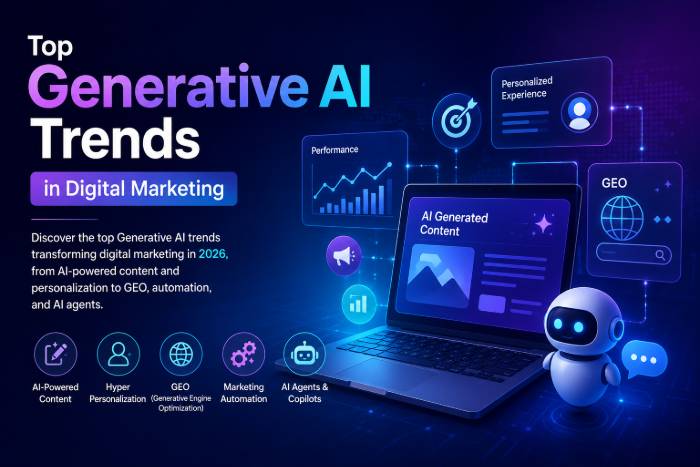
Top Generative AI Trends in Digital Marketing
Digital marketing is entering a new stage in which artificial intelligence is no longer just an optional tool for saving time. For marketers learning through a Digital Marketing course, understanding generative AI is increasingly important because it is affecting content, advertising, SEO, customer service, analytics, and campaign planning. Recent industry research shows how fast this change is happening: Salesforce reports that 81% of marketers in India have started using AI. Even more, 92% say they have begun improving their work to better align with AI-generated responses like ChatGPT and Google AI Overviews. The key question is no longer whether marketers should use AI, but how to smartly combine automation with human creativity, brand knowledge, and customer understanding.
Table of Contents
How Generative AI Is Changing Digital Marketing
Generative AI can quickly create text, images, videos, ideas, summaries, campaign versions, scripts, and other marketing materials in seconds. This greatly changes the cost and effort of making content. Instead of spending hours starting every campaign from scratch, marketers can use AI to generate initial ideas and then focus more on refining strategy and creativity. HubSpot’s 2026 research found that 71% of marketers say AI helps them produce much more content, but 53% also find it hard to make that content stand out in a world full of AI-created material.
From Content Creation to Marketing Intelligence
The biggest change is that AI is going beyond just helping with writing. Modern marketing systems can study customer behavior, identify patterns, suggest actions, and, more often, carry out parts of a campaign. BCG’s 2026 CMO research found that 96% of CMOs said AI is driving a complete change, but only about one-third have fully implemented it. This difference creates a big opportunity for businesses that learn to use AI effectively rather than just adding another chatbot to their toolset.
AI-Powered Content Creation
AI-assisted content creation is one of the most obvious trends in generative AI. Marketers can use AI for blog outlines, social media captions, ad copy, email drafts, product descriptions, video scripts, and content reuse. Typeform’s 2026 research found that 79% of marketers use AI for writing, making it one of the most common uses of AI in marketing.
Faster Content Production
Speed is important, but speed alone is not a marketing plan. Businesses still need original ideas, correct information, clear positioning, and a brand voice people recognize. The best approach is likely to be AI-assisted content, where technology handles repetitive tasks while humans add experience, opinions, storytelling, and quality checks.
Hyper-Personalized Marketing
Generative AI is making personalization much more advanced. Instead of sending a single message to everyone, marketers can create tailored messages based on customer interests, behavior, buying stage, location, and past interactions. Salesforce reports that 92% of marketers in India see customers expecting more two-way conversations with brands.
Personalized Customer Experiences
Imagine an online shopper getting product suggestions based on past purchases, while another visitor sees very different messages based on their browsing habits. AI can help create these variations at scale. However, personalization depends heavily on high-quality customer data; Salesforce notes that disconnected and irrelevant data is a major obstacle to effective AI-driven engagement.
Generative AI and SEO
SEO is changing as more people turn to AI systems for answers rather than relying solely on traditional search results. Marketers need to consider how their brand, expertise, products, and content appear in AI-generated answers. This has increased interest in Answer Engine Optimization (AEO) and Generative Engine Optimization (GEO).
The Rise of GEO and AEO
Traditional SEO focuses mainly on rankings and natural clicks. GEO adds another goal: becoming a trusted source that AI systems can understand, mention, and suggest. This means marketers should focus on reliable information, clear answers, organized content, original research, trustworthy references, and consistent brand details across the web.
AI-Powered Search and AI Overviews
AI-powered search is changing how websites and search engines work together. Google AI Overviews and conversational search can summarise information before users visit specific websites. Salesforce reports that half of Google searches now include AI summaries that can skip brand websites completely.
For marketers, this means visibility can no longer be measured only by traditional rankings. Brand mentions, references, recognition of key information, review quality, and inclusion in AI-generated answers are becoming increasingly important factors in search visibility.
Agentic AI in Digital Marketing. One of the most important new trends is agentic AI. Unlike a simple chatbot that waits for commands, an AI agent can plan multiple steps, use connected tools, analyze results, and carry out tasks with minimal human help. Current marketing uses include campaign analysis, research, reporting, content processes, and improvement.
Autonomous Marketing Workflows
For example, an AI agent could analyze campaign results, identify an underperforming audience group, suggest creative changes, create different versions, and prepare a performance report. This could greatly reduce repetitive manual work. Still, marketers need approval systems, clear goals, data controls, and human checks before letting AI make important decisions on its own.
AI-Generated Visual and Video Content
Generative AI is also changing visual marketing. Marketers can create concept images, campaign versions, product pictures, storyboards, short videos, and other creative materials much faster than traditional production methods. Canva’s 2026 research found that 97% of marketing leaders use AI in their daily creative work, underscoring how deeply AI has become integrated into professional creative processes.
The challenge is standing out. When everyone can quickly create attractive visuals, originality becomes more important. Brands need clear visual styles and human creative guidance rather than endless generic AI-generated images.
Conversational Marketing and AI Assistants
Consumers increasConsumers expect brands to answer questions more and more naturally. AI assistants can help with customer service, product discovery, lead qualification, appointment booking, and follow-up communication. The experience can feel less like filling out a form and more like talking with a helpful sales representative. Creates opportunities for businesses to capture intent earlier. Instead of asking visitors to navigate several pages, an AI assistant can help them identify the right product or service through a conversational interaction.
Predictive Analytics and Customer Insights
Generative AI works especially well when combined with predictive analytics. AI can summarise large amounts of data, find unusual patterns, group audiences, and help marketers understand what might happen next. This lets marketing teams move from just reporting what happened to deciding what to do about it.
The combination of predictive models and generative interfaces is highly effective, enabling marketers to work with complex data in everyday language rather than relying solely on technical dashboards.
AI in Performance Marketing
Paid advertising platforms are increasingly using AI for bidding, targeting, ad creation, and improving results. Marketers can create many ad ideas and use automated systems to test different audiences, placements, and messages. This speeds up testing and lets smaller teams run advanced campaigns.
However, automation does not remove the need for smart planning. Bad positioning, weak offers, or wrong audience guesses can still lead to poor results—just more quickly.
Automated Email Marketing
Email marketing is becoming more flexible with generative AI. AI can help create subject lines, email copy, product suggestions, follow-up messages, and versions tailored to different customer groups. Instead of sending the same campaign to everyone, businesses can create communications that better fit the situation.
The best email strategies will blend AI-generated versions with customer data, behavioral triggers, and a consistent brand voice.
Voice and Multimodal Marketing
Generative AI is working across a wider range of content types, including text, images, audio, video, and other forms of information. This opens new chances for voice search, video content, visual product discovery, and interactive campaigns.
A customer might take a photo of a product, ask a question by voice, and get a personalized recommendation. Marketing then becomes less about separate channels and more about creating connected experiences across many formats.
AI-Powered Social Media Marketing
Social media teams can use generative AI to generate ideas, write captions, repurpose content, spot trends, research audiences, and create variations. One long article can turn into many social posts, video scripts, carousel ideas, and email concepts.
But social media is still mainly human. Audiences can quickly notice repeated AI-generated content. Brands that use AI to post more without better ideas risk being ignored in a crowded feed.
Human Creativity in the AI Era
The most important trend is the growing value of human creativity. Canva’s research found that seven out of ten consumers feel AI-generated ads can lack something, even though many accept AI when it creates something useful or relevant.
That missing element is often personality. AI can create a good ad, but human marketers understand cultural details, emotions, customer frustrations, brand history, and the small things that make communication memorable. Responsible AI.
More AI means more responsibility. Marketers must consider customer consent, data security, transparency, copyright, misinformation, and the accuracy of AI-generated information. Recent reports have also highlighted concerns that AI-generated search summaries contain inaccurate information about businesses.
Responsible AI should therefore become part of marketing strategy rather than an afterthought. Human review, reliable data sources, appropriate disclosure, and clear governance can help protect both customers and brands.
The Future Skills Digital Marketers Need
The modern marketer will need a combination of traditional marketing knowledge and AI literacy. Knowing how to write a prompt is useful, but understanding customer psychology, positioning, SEO, analytics, conversion optimization, branding, and campaign strategy remains essential.
The most valuable professionals will likely be those who can direct AI rather than operate AI tools. They will know which tasks to automate, which decisions require human judgment, and how to turn AI-generated output into measurable business results.
How Businesses Can Prepare for AI-First Marketing
Businesses should start with practical use cases rather than attempting to automate everything at once. Begin with content research, reporting, creative ideation, customer segmentation, or workflow automation, measure the results, and gradually expand.
For organizations and learners seeking practical implementation, Victorious Digital focuses on industry-oriented digital marketing education that integrates modern tools, practical campaigns, AI, and real-world marketing skills. The goal should not be to learn every AI tool available; it should be to understand how technology can solve genuine marketing problems.
Conclusion
Generative AI is changing digital marketing across content production, customer engagement, SEO, advertising, analytics, and campaign automation. The strongest trend is not simply that machines can create more content—it is that AI is becoming part of the decision-making and execution layer of marketing. Current research shows rapid adoption, particularly in India, even as businesses discover that trust, creativity, data quality, and human judgment remain critical.
The future belongs to marketers who combine AI efficiency with human intelligence. AI can provide the engine, but marketers still need to decide where they are going and why.
FAQs
1. What is the biggest generative AI trend in digital marketing?
AI-powered personalization, content creation, AI search optimization, and agentic AI are among the most significant trends shaping digital marketing in 2026.
2. Will generative AI replace digital marketers?
Generative AI is more likely to automate repetitive tasks than completely replace marketers. Strategy, creativity, customer understanding, brand positioning, and judgment remain highly valuable.
3. How is AI changing SEO?
AI is expanding SEO beyond traditional rankings. Marketers increasingly need to optimize content for AI-generated answers, AI Overviews, conversational search, AEO, and GEO.
4. Why is human creativity still important in AI marketing?
Because AI can generate large volumes of content, originality and authentic brand perspective become more important. Human creativity helps brands create distinctive messages that audiences remember.
5. What should digital marketers learn about AI?
Marketers should learn generative AI, prompt design, AI-assisted content creation, automation, analytics, AEO/GEO, personalization, AI advertising tools, and responsible AI practices while maintaining strong fundamentals in marketing strategy.
Read Also : Google Skillshop Certification – The Complete Guide