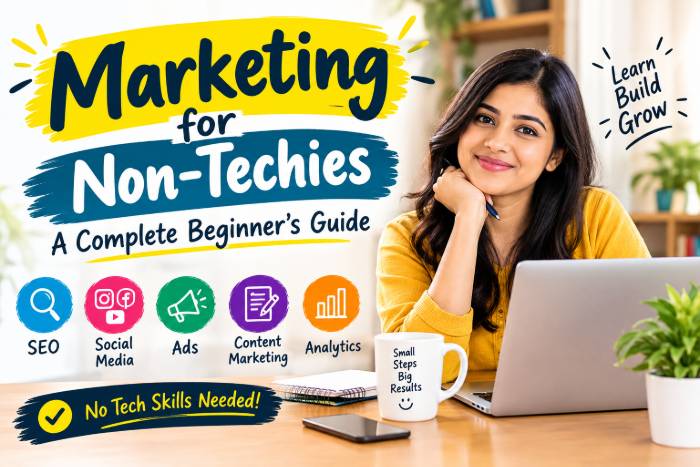
Marketing for Non-Techies: A Complete Beginner’s Guide
Table of Contents
What Is Digital Marketing?
Digital marketing can sound complicated when you hear terms like SEO, conversion tracking, PPC, analytics, algorithms, automation, and remarketing. But the basic idea is simple: digital marketing is the promotion of a product, service, brand, or idea through online channels such as search engines, websites, social media, email, videos, and online ads. You do not need to be a programmer or tech expert to understand it. A Digital Marketing course can help beginners learn these ideas step by step, but the most important thing is curiosity and a willingness to practice. Think of digital marketing like running a shop in a busy online marketplace. Your website is your shop, social media is your way of talking with customers, search engines help people find you, and advertising brings the right visitors to your door.
Digital Marketing in Simple Words
Imagine you own a small bakery. You post pictures of your cakes on Instagram, create a website where customers can order, show up on Google when someone searches for a nearby bakery, send special offers by email, and run an ad promoting your weekend discount. All these activities are examples of digital marketing. The technology behind them may seem advanced, but the marketing ideas are familiar: know your customer, share a helpful message, build trust, and encourage action. This is why people without tech skills can become great digital marketers. You don’t have to build the technology yourself; you need to understand how the tools work and how to use them smartly.
Why Digital Marketing Matters Today
The importance of digital marketing is clearer when you see how people use the internet. DataReportal’s Digital 2026 India report says India had 1.03 billion internet users by the end of 2025, with 70% of the population online. Ipsos also said digital ads accounted for 44% of India’s advertising market in FY2025, with spending of around ₹49,000 crore. They expect digital ad spending to reach about ₹56,400 crore in FY2026. These numbers show why businesses need people who understand how customers behave online. Whether you want a job, freelance work, or to grow a business, digital marketing is now a useful skill, not just a technical specialty.
Why Non-Techies Should Learn Digital Marketing
You might wonder, “Do I need coding skills?” Usually, no. A good digital marketer needs stronger skills in communication, creativity, research, customer understanding, clear thinking, and problem-solving than in programming. You can learn website tools like WordPress without becoming a web developer, use ad platforms without building them, and understand data without being a data scientist. For someone changing careers or starting fresh, this makes digital marketing easy to get started with and can also help in other jobs: a teacher can promote courses, a photographer can find clients, a shop owner can sell online, and a business owner can get leads without relying fully on an agency.
Career Opportunities
Digital marketing has created a broad range of career paths. Beginners can eventually specialize in SEO, social media, paid advertising, content marketing, email marketing, marketing analytics, influencer marketing, e-commerce marketing, or marketing automation. Some professionals choose a single specialization, while others become generalists capable of managing an entire digital strategy. The important point is that you do not have to master everything on day one. Start with the fundamentals, practice on real projects, and gradually identify the areas where your skills and interests are strongest.
Business Growth Opportunities
For business owners, digital marketing can offer something traditional ads often can’t: clear feedback. You can see how many people visited a page, clicked an ad, watched a video, sent a question, or bought a product. This information helps you make decisions based on facts instead of guesses. Sensor Tower says India’s digital ad market was over $4.2 billion in 2025 and expects it to reach about $5 billion in 2026. As more businesses compete online, knowing digital marketing helps entrepreneurs make smarter choices about where to spend their time and money.
Main Areas of Digital Marketing
Digital marketing covers several connected areas. SEO helps your website show up in natural search results, while social media marketing helps you talk with communities on platforms like Instagram, Facebook, LinkedIn, and YouTube. Content marketing uses helpful articles, videos, guides, pictures, podcasts, and other materials to attract and teach audiences. Paid ads let businesses reach specific groups quickly, while email marketing helps build relationships with people who are already interested. Beginners don’t need to master all these areas right away; understanding how they work together is the first big step.
Search Engine Optimization (SEO)
SEO means improving a website so that search engines can better understand its content and users can find it through relevant searches. For beginners, start with simple ideas like keywords, what people want to find, helpful content, website layout, internal links, user experience, and backlinks. Instead of thinking of SEO as “tricking Google,” think of it as making your website the best answer to a customer’s question. Google offers learning resources for digital marketing skills, including beginner Google Ads training and certificates. Regular learning and hands-on practice are much more useful than memorizing many SEO rules.
Social Media Marketing
Social media marketing is not just posting nice pictures every day. Good social media marketing starts with knowing your audience and deciding what you want your content to do. A business might use educational posts to demonstrate expertise, short videos to reach more people, testimonials to build trust, and ads to generate inquiries. DataReportal’s latest India data shows how big platforms like YouTube, Instagram, and Facebook are, making social media a key part of today’s customer journey. The key is to be consistent and try new things: make content, see how people react, and improve your approach.
Content Marketing
Content is the link between a business and its audience. Instead of asking someone to buy right away, content marketing gives them a reason to trust you first. A fitness trainer might share workout guides, a software company might make tutorials, and a school might share career advice. Good content answers questions, solves problems, demonstrates expertise, or helps people make decisions. For beginners, a simple rule is to create content for people first, then make it SEO-friendly.
Paid Advertising: Optimize Google Ads
Paid advertising lets businesses reach potential customers without waiting months for natural visibility. Google Ads, Meta ads, YouTube ads, and other platforms let marketers choose audiences, budgets, goals, ad designs, and conversion targets. The challenge is not just clicking “launch”; it is understanding why an ad works or doesn’t. You need to track metrics like views, clicks, click-through rate, cost per click, leads, conversion rate, and return on ad spend. Starting with a small budget and learning from results is usually better for beginners than spending a lot without a plan to measure success.
Email Marketing and Lead Generation
Not every visitor is ready to buy right away. Email marketing helps businesses keep in touch with people who have shown interest. A company might offer a free guide for an email address, then send helpful information before offering a product or service. This is called lead nurturing. The goal is to guide someone from knowing about you to being interested, thinking it over, and finally taking action without sending too many sales messages.
Analytics and Conversion Tracking
Analytics is where digital marketing can be measured. Instead of asking, “Did our campaign work?”, you can check what happened at each step of the customer journey. You might find that an ad brought thousands of visitors but very few inquiries, meaning the landing page or offer needs fixing. Another campaign might get fewer clicks but bring in many more customers. Learning basic analytics helps non-tech people make better decisions by turning marketing into a cycle of testing, measuring, learning, and improving.
How AI Is Changing Digital Marketing
Artificial intelligence is quickly becoming part of daily marketing work. Marketers can use AI to generate content ideas, analyze customer feedback, create multiple versions, summarise research, personalize messages, automate routine tasks, and analyze campaign results. But AI should be seen as a helper, not an unquestioned expert. Human judgment remains important for brand style, accuracy, originality, customer understanding, strategy, and ethics. The best skill for beginners is not just learning AI tools, but learning how to use AI alongside basic marketing skills.
How to Start Learning Digital Marketing
The easiest way is to avoid trying to learn everything at once. Start with the customer journey and basic marketing ideas, then learn SEO, content, social media, paid ads, email, and analytics step by step. Build a small website or practice project where you can try keywords, content, social posts, and simple campaigns. Keep track of what you changed and what happened next. If you like structured learning, find a practical training program that includes projects, tools, assignments, analytics, and current marketing methods rather than just theory.
Choosing the Right Learning Path
When evaluating digital marketing courses in Pune, for example, do not judge a program only by its duration or certificate. Ask whether you will actually work on websites, SEO campaigns, social media content, Google Ads, analytics, lead generation, and real-world case studies. A good learning environment should allow you to make mistakes safely, analyze results, and receive feedback. You should also check whether the curriculum is up to date with AI-assisted marketing and changing search behavior. Your goal should not simply be to collect a certificate; it should be to finish the course with enough practical confidence to explain what you did and why you did it.
Common Mistakes Beginners Should Avoid
One common mistake is trying to learn every tool before understanding marketing fundamentals. Another is copying competitors without understanding their audience, positioning, or strategy. Beginners also frequently focus on vanity metrics such as likes and followers while overlooking leads, sales, quality of engagement, and customer retention. Avoid expecting instant results from SEO or assuming that every paid campaign will be profitable from the first attempt. Digital marketing is closer to planting and managing a garden than to flipping a switch: you test, observe, adjust, remove what doesn’t work, and continue improving.
Conclusion
Digital marketing is no longer reserved for technology professionals. It is a practical business and career skill built around understanding people, communicating value, using digital channels, and measuring outcomes. India’s growing internet audience and expanding digital advertising market demonstrate why these skills remain important. Whether you are a student, professional, entrepreneur, freelancer, or complete beginner, you can start with the fundamentals and gradually develop specialized expertise. The best time to learn is not when you understand every technical term; it is when you decide to begin practicing.
Frequently Asked Questions
1. Can a non-technical person learn digital marketing?
Yes. Digital marketing does not require advanced programming knowledge. Beginners can learn the major concepts through structured study and practical projects.
2. How long does it take to learn digital marketing?
The fundamentals can be learned within a few months with consistent practice. Becoming highly skilled takes longer because platforms, customer behavior, advertising systems, and AI tools are constantly evolving.
3. Is coding necessary for digital marketing?
Coding is not essential for most digital marketing roles. Basic technical knowledge can be helpful, particularly for SEO, websites, analytics, and automation, but many marketing tasks can be performed without writing code.
4. Which digital marketing skill should beginners learn first?
Start with marketing fundamentals, customer research, content, SEO, social media, and analytics. After understanding the basics, you can specialize in areas such as Google Ads, SEO, social media, or marketing automation.
5. How can I get practical experience?
Create a practice website, manage a small social media page, conduct keyword research, write content, analyze competitors, and experiment with small campaigns. Building a portfolio of actual projects is one of the best ways to demonstrate your skills. If you are looking for structured, practical training, Victorious Digital is an option to explore when comparing digital marketing learning programs and career-focused training.
Read Also: Top Generative AI Trends in Digital Marketing