
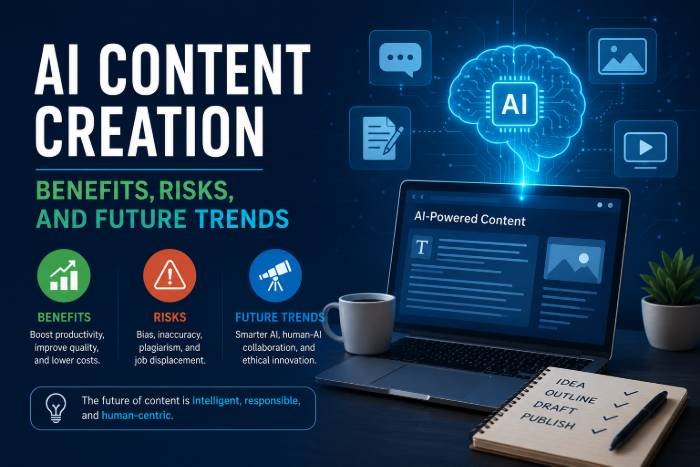
AI Content Creation: Benefits, Risks, and Future Trends
Artificial Intelligence (AI) has transformed the way businesses, marketers, and creators produce content. From generating blog articles and social media posts to creating videos and images, AI-powered tools are helping organizations save time and improve productivity. As technologies like ChatGPT, Gemini, Claude, and AI image generators continue to evolve, content creation is becoming faster, smarter, and more personalized.
However, while AI offers tremendous opportunities, it also presents challenges related to originality, misinformation, and ethical concerns. Understanding both the advantages and risks is essential for businesses and individuals who want to use AI responsibly.
In this article, we will explore the benefits, risks, and future trends of AI content creation.
Table of Contents
What is AI Content Creation?
AI content creation refers to the use of artificial intelligence tools and machine learning algorithms to generate various forms of content, including:
- Blog posts
- Website content
- Social media captions
- Product descriptions
- Email marketing campaigns
- Video scripts
- Images and graphics
- Podcasts and voiceovers
- Ad copies
- E-books and reports
Modern AI tools can analyze massive amounts of data, understand language patterns, and create human-like content in seconds.
Benefits of AI Content Creation
AI is revolutionizing digital marketing and content production. Here are some major advantages:
1. Faster Content Production
Creating high-quality content manually can take hours or even days. AI tools can generate drafts within minutes.
Benefits include:
- Quick article creation
- Faster social media content generation
- Reduced workload for writers
- Increased productivity
This enables businesses to maintain consistent content publishing schedules.
2. Cost-Effective Solution
Hiring a large content team can be expensive. AI tools help reduce operational costs by assisting with:
- Blog writing
- Copywriting
- Content ideas
- SEO optimization
- Email marketing content
Small businesses and startups can especially benefit from AI-driven content creation.
3. Improved SEO Performance
AI-powered writing tools can optimize content for search engines by:
- Suggesting keywords
- Creating SEO-friendly headings
- Improving readability
- Generating meta titles and descriptions
- Structuring content effectively
This helps websites rank higher on Google and attract organic traffic.
4. Personalized Content Experiences
AI can analyze user behavior and create customized content for different audiences.
Examples include:
- Personalized emails
- Product recommendations
- Dynamic website content
- Targeted advertisements
Personalization improves engagement and conversion rates.
5. Better Content Ideation
Many creators struggle with writer’s block. AI tools can generate:
- Blog topics
- Video ideas
- Social media captions
- Marketing campaigns
- Email subject lines
This helps marketers maintain a continuous flow of fresh ideas.
6. Multilingual Content Creation
AI translation capabilities enable businesses to reach global audiences.
Advantages include:
- Content localization
- Multiple language support
- Faster translation
- International market expansion
Companies can serve customers across different regions without large translation teams.
7. Consistency Across Platforms
AI helps maintain brand voice and messaging across:
- Websites
- Email campaigns
- YouTube descriptions
Consistent branding increases trust and recognition.
Popular AI Content Creation Tools
Several AI tools are transforming content marketing:
Writing Tools
- ChatGPT
- Gemini
- Claude
- Jasper AI
- Copy.ai
Image Generation Tools
- Midjourney
- DALL-E
- Adobe Firefly
- Canva AI
Video Creation Tools
- Synthesia
- Runway ML
- Pictory
- InVideo AI
SEO Tools
- Surfer SEO
- Frase
- SEMrush AI
- Ahrefs AI
These tools help creators work faster while improving quality.
Risks and Challenges of AI Content Creation
Despite its advantages, AI content creation comes with certain risks.
1. Lack of Originality
AI generates content based on existing data patterns. Sometimes the content may:
- Sound repetitive
- Lack creativity
- Produce generic outputs
- Miss emotional depth
Human creativity is still essential for producing unique and engaging content.
2. Misinformation and Inaccuracies
AI tools can occasionally generate incorrect information.
Potential issues include:
- Fake facts
- Outdated statistics
- Misleading answers
- Inaccurate references
Therefore, human review and fact-checking are necessary before publishing.
3. Plagiarism Concerns
AI-generated content may unintentionally resemble existing material.
Businesses should:
- Use plagiarism checkers
- Add human editing
- Verify originality
- Create unique perspectives
Maintaining authenticity is critical for SEO and brand credibility.
4. Ethical Issues
AI raises several ethical concerns:
- Deepfakes
- Copyright disputes
- Data privacy
- Bias in AI models
- Lack of transparency
Responsible AI usage is becoming increasingly important.
5. Overdependence on AI
Relying entirely on AI can reduce:
- Human creativity
- Critical thinking
- Storytelling abilities
- Brand personality
AI should assist humans rather than replace them completely.
6. Google’s Quality Standards
Google prioritizes helpful and experience-based content. Low-quality AI-generated content can lead to:
- Poor rankings
- Reduced trust
- Low engagement
- High bounce rates
Businesses should combine AI efficiency with human expertise.
Best Practices for Using AI in Content Creation
To achieve better results, follow these guidelines:
Use AI as an Assistant
AI should help with:
- Research
- Drafting
- Brainstorming
- Outlining
Human writers should refine and enhance the content.
Fact-Check Information
Always verify:
- Statistics
- Dates
- Claims
- References
Accuracy builds credibility.
Add Human Experience
Include:
- Real examples
- Case studies
- Personal insights
- Expert opinions
This improves trust and authenticity.
Optimize for Readers First
Focus on:
- Readability
- User intent
- Helpful information
- Clear formatting
Avoid keyword stuffing and robotic language.
Maintain Brand Voice
Ensure your content reflects:
- Company values
- Writing style
- Target audience preferences
- Unique personality
Future Trends in AI Content Creation
AI technology is evolving rapidly. Several exciting trends are shaping the future.
1. Hyper-Personalized Content
AI will deliver content based on:
- User preferences
- Browsing behavior
- Purchase history
- Demographics
This will improve customer engagement significantly.
2. AI Video Generation
Video AI tools are becoming more powerful.
Future capabilities include:
- AI avatars
- Realistic voiceovers
- Automatic editing
- Personalized videos
Video marketing will become more accessible and affordable.
3. Multimodal AI Systems
Future AI systems will combine:
- Text
- Images
- Audio
- Video
Users will be able to create entire campaigns from a single prompt.
4. Voice and Conversational Content
As voice assistants become more common, AI will help create:
- Podcasts
- Audio blogs
- Voice search content
- Interactive experiences
Voice-based content marketing will continue to grow.
5. Real-Time Content Optimization
AI tools will automatically analyze:
- Search trends
- User behavior
- Engagement metrics
- Conversion data
Content can then be updated dynamically to improve performance.
6. Human-AI Collaboration
The future is not about humans versus AI but humans working alongside AI.
Writers, marketers, and designers will use AI to:
- Increase productivity
- Generate ideas
- Automate repetitive tasks
- Focus on creativity and strategy
Human expertise will remain valuable.
Conclusion
AI content creation is reshaping the digital landscape. It offers remarkable benefits such as faster production, improved SEO, cost savings, and personalized experiences. However, risks like misinformation, lack of originality, ethical concerns, and overdependence must be managed carefully.
The future of content creation lies in collaboration between humans and artificial intelligence. Businesses that combine AI efficiency with human creativity will have a competitive advantage in the coming years.
Instead of replacing content creators, AI is becoming a powerful partner that enables marketers, writers, and businesses to create better, faster, and smarter content for the digital age.
Key Takeaways
- AI speeds up content production and reduces costs.
- AI improves SEO and personalization.
- Human creativity remains essential.
- Fact-checking and originality are critical.
- Ethical AI usage is increasingly important.
- Future trends include AI video, voice content, and hyper-personalization.
- Human-AI collaboration will define the next generation of content marketing.
Frequently Asked Questions (FAQs)
1. What is AI content creation?
AI content creation is the process of using artificial intelligence tools to generate written, visual, audio, or video content. These tools can create blog posts, social media captions, emails, product descriptions, and much more with minimal human effort.
2. What are the benefits of AI content creation?
AI content creation offers several advantages, including:
- Faster content production
- Reduced costs
- Improved SEO optimization
- Better personalization
- Consistent brand messaging
- Multilingual content capabilities
- Enhanced productivity
3. Which AI tools are popular for content creation?
Some widely used AI content creation tools include:
- ChatGPT
- Google Gemini
- Claude AI
- Jasper AI
- Copy.ai
- Canva AI
- Midjourney
- DALL-E
- Synthesia
- Surfer SEO
4. Can AI completely replace human content writers?
No. AI can assist with research, idea generation, and drafting, but human creativity, experience, emotional intelligence, and critical thinking are still essential for producing high-quality and authentic content.
5. Is AI-generated content good for SEO?
Yes, AI-generated content can support SEO when combined with human editing and expertise. Google values helpful, original, and user-focused content rather than whether it is written by AI or humans.
6. What are the risks of AI content creation?
Some common risks include:
- Inaccurate information
- Lack of originality
- Plagiarism concerns
- Ethical and copyright issues
- Bias in AI-generated outputs
- Overdependence on automation
Read Also : Digital Marketing Course Fees in Pune, Duration & Modules