How Does Digital Marketing Benefit Business Owners?
Running a business today is very different from how it was a decade ago. According to a report by Statista, over 80% of consumers research online before making a purchase or choosing a service, making online visibility essential. This essay argues that mastering digital marketing is necessary for business owners to attract, engage, and convert customers while remaining competitive in today’s market. For instance, a local bakery that invests in search engine optimization and maintains an active Instagram presence may see an increase in orders due to greater online exposure than competitors that do not employ digital marketing. Digital marketing enables business owners, whether they operate a startup, retail store, factory, or service business, to reach their target audience efficiently and cost-effectively. It also helps create trust, increase sales, and compete with larger brands through analytics-based strategies.
To get started, focus on a few essential steps. First, create a professional website to showcase your products or services and provide clear contact information. Next, set up your Google My Business profile so local customers can easily find you in search results and on maps. Finally, establish your business presence on key social media platforms where your target audience spends time. These first actions build a solid foundation for your digital marketing efforts and make your business more visible online.
Table of Contents
Comprehending Digital Marketing in Today’s Business World
The most effective digital marketing strategies depend on each business type and play a key role in increasing online visibility and competitiveness. For example, local businesses can enhance their presence and attract nearby customers by prioritising local SEO, optimising Google My Business profiles, and engaging audiences on social media platforms. In contrast, e-commerce stores commonly achieve higher sales and brand recognition using targeted online advertising, personalised email marketing campaigns, and customer product reviews. Similarly, service providers strengthen their reputation and foster trust by producing informative content and collecting client testimonials. By aligning these strategies with their specific operational contexts, business owners can more effectively reach their target audiences, build credibility, and support long-term growth within the digital marketplace.
Small businesses can measure return on investment (ROI) by tracking critical metrics such as website traffic, leads, sales, cost per lead, and conversion rates using free tools like Google Analytics. For example, a business might monitor its conversion rate, defined as the percentage of website visitors who complete a desired action such as making a purchase or filling out a contact form. By analysing these data points over time, business owners can determine which marketing tactics are most effective; for instance, an increase in conversion rate from 2% to 4% following an email campaign suggests the campaign’s success, while stagnant or declining numbers indicate the need for strategic revisions.
Common mistakes to avoid include neglecting mobile-friendly websites, failing to update social media regularly, ignoring customer reviews, and skipping analytics. Staying consistent, tracking your results, and focusing on valuable content help create a strong online presence.
Customers now use Google, YouTube, Instagram, and online reviews to inform their purchasing decisions. Without an online presence, your business risks losing customers to competitors. Digital marketing keeps your business visible throughout the customer journey. These strategies help build awareness, generate leads, and encourage repeat purchases.
Why Every Business Needs an Online Presence
Customers expect businesses to keep a professional website, have active social media channels, and offer authentic customer reviews. Creating a solid online presence builds confidence and ensures customers can easily access information about your products, pricing, operating hours, and contact details. Additionally, providing useful content plus engaging consistently with your audience marks you as an authority in your field.
A key advantage is that your business is accessible online at all times. Unlike physical stores with limited hours, your website and social media are available 24/7. Customers can discover your business, browse products, ask questions, or place orders at their convenience. This continuous visibility generates more leads and sales, while increasing brand recognition across multiple web platforms.
Establishing Trust Through Digital Channels
Trust plays a key role in purchasing decisions, strongly influencing consumer behaviour. Customers are more inclined to engage with businesses that exhibit professionalism, transparency, and responsiveness through their online presence. A range of digital factors—including consistent positive Google reviews, authentic customer testimonials, regularly updated informative blog posts, and interactive social media—serves as evidence of a brand’s credibility and reliability. These elements contribute to trust-building by reducing the perceived risk of transactions and signalling a commitment to customer satisfaction. Furthermore, when businesses actively address common questions, disseminate practical information, and resolve customer questions efficiently, they move beyond transactional relationships and assume the role of a trusted advisor. This deeper level of engagement not only distinguishes a business from competitors but also forms an emotional connection with customers. In the long term, such trust cultivates customer loyalty, promotes repeat business, and increases the likelihood of positive referrals—key components in sustaining business growth.
Reaching Customers Beyond Local Markets
Traditional marketing typically restricts businesses to their local area. Digital marketing eliminates these boundaries, allowing you to reach customers in other cities, states, or countries. For example, a small graphic design studio might develop a portfolio of past work on Instagram, regularly post client testimonials and design process videos, and run targeted Facebook or Google Ads aimed at small business owners in major metropolitan areas, such as New York, Chicago, or Los Angeles. By using geographical and demographic targeting on these platforms, the studio can attract clients from across the country, rather than relying exclusively on local word-of-mouth. Local companies may use local SEO to attract nearby customers and leverage ads or social media to expand into new markets. Service providers, in particular, can promote their offerings to a larger audience. As your business grows, digital campaigns can be adjusted to target specific groups and regions accurately.
Major Benefits of Digital Marketing
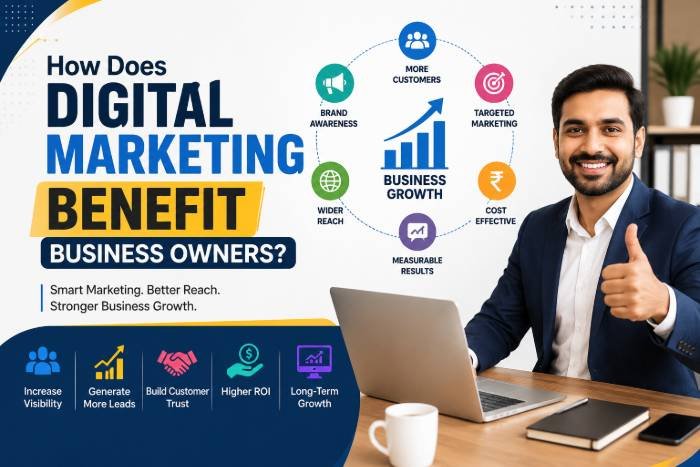
A major benefit of digital marketing is its affordability. Small firms can compete with larger companies without needing large advertising budgets. Platforms like Google Ads and Facebook Ads let you start with a modest budget and still reach your target audience. Analytics tools help business owners track website traffic, leads, conversion rates, customer engagement, and advertising return on investment. By relying on real data instead of guesswork, you can make informed decisions and continually improve your marketing effectiveness and profitability over time.
Cost-Effective Marketing
Digital marketing offers greater value than traditional channels such as TV, newspapers, or billboards. You can set daily budgets, pause campaigns at any time, and adjust spending based on performance. Free methods like SEO, blogging, and social media can also deliver ongoing results.
Small businesses profit notably by competing with larger companies without high advertising costs. Targeting the right audience guarantees each marketing dollar is used efficiently, cutting waste and improving ROI. Digital marketing allows you to target specific audiences based on age, gender, interests, location, buying behaviour, income, and previous website visits. This level of personalisation increases campaign effectiveness.
Rather than advertising to a broad audience, businesses can focus their efforts on people most likely to be interested in their products or services. This precise approach leads to more clicks, higher-quality leads, increased sales, and lower advertising costs. Consistently sharing valuable content, posting engaging updates on social media, optimising your site for search engines, working with influencers, and sending targeted email campaigns all help build brand recognition. When your business appears regularly in Google searches and on social media, customers become familiar with you. Even if they are not ready to buy right away, seeing your brand many times makes them more likely to choose you in the future.
Higher Return on Investment
Every business owner wants the best results from their marketing efforts. Digital marketing supports this by allowing you to track and optimise campaigns in real time. If an ad is underperforming, you can adjust or stop it immediately and reallocate resources to higher-performing campaigns. This analytics-based approach reduces waste and increases profitability, making digital marketing highly effective. Using multiple strategies together, such as SEO, content marketing, social media, email marketing, and paid ads, maximises your exposure and effect.
When you use these digital strategies together, your business builds a strong online presence that attracts visitors, generates leads, fosters relationships, and increases sales. The key is to understand your customers and offer helpful content at each stage of their buying journey. To improve your results, use simple data tools, such as Google Analytics, to track how many people visit your website, which pages they like most, and how many turn into customers. Monitor your ads’ performance and see which posts or campaigns get the best response. If a strategy works well, keep using it. If it does not yield results, modify your approach or allocate your time and budget to higher-performing tactics. Consistently reviewing this data makes it easier to focus on what works best, serve your customers better, and support your business growth.
Common Mistakes Business Owners Should Avoid
Many businesses expect immediate results from digital marketing and become discouraged if they do not see quick progress. Building trust, increasing online visibility, and achieving strong search rankings require time and consistent effort. Another common mistake is prioritising advertising over delivering genuine value to customers.
Ignoring analytics represents another major mistake. Without tracking your campaigns, you miss opportunities for improvement. Additional issues, such as a lack of a mobile-friendly website, inconsistent branding, low-quality content, or failure to respond to client inquiries, can also undermine your digital marketing efforts. Adopting new technologies such as artificial intelligence, voice search, automation, personalisation, and predictive analytics can help businesses deliver faster, more personalised experiences, thereby offering a competitive advantage.
Constant education is essential for business owners who want to remain competitive. Investing in training helps you stay current with new trends, technologies, and evolving customer behaviours. To build practical skills, improve your online presence, and grow your business, you can enrol in Digital Marketing Courses in Pune for direct experience with leading tools and strategies. If you are based elsewhere or prefer adaptable learning options, there are many online courses and free resources available. Services like Coursera, Google Digital Garage, HubSpot Academy, and LinkedIn Learning offer comprehensive digital marketing modules for learners of all skill levels. These resources allow you to study at your own pace, often at little or no cost, and access practical training to boost your business’s online success.
Conclusion
Digital marketing has changed how businesses reach customers, generate leads, and increase revenue. It provides affordable, measurable, and flexible solutions, enabling any business to compete in today’s digital landscape. By improving your online presence, strengthening customer relationships, increasing sales, and optimising your marketing budget, digital marketing has become vital for business growth. In light of this evidence, business owners should not only adopt digital strategies but also commit to continual education and modification as technologies and consumer behaviours evolve. Taking the following steps will ensure that businesses preserve their competitive advantage and are equipped to respond to future trends and obstacles in an ever more digital marketplace.
Read Also : MBA vs Digital Marketing Course in India: Which One is Better for Growth