SEO vs GEO vs AEO: Complete Beginner Guide
Search is changing faster than ever. A few years ago, ranking on Google was enough to get a steady website visitors. Today, people search using ChatGPT, Gemini, Perplexity, Claude, and Google’s AI Overviews. Instead of scrolling through ten blue links, users want quick answers. This change has brought two new optimisation methods alongside traditional SEO—Answer Engine Optimisation (AEO) and Generative Engine Optimisation (GEO).
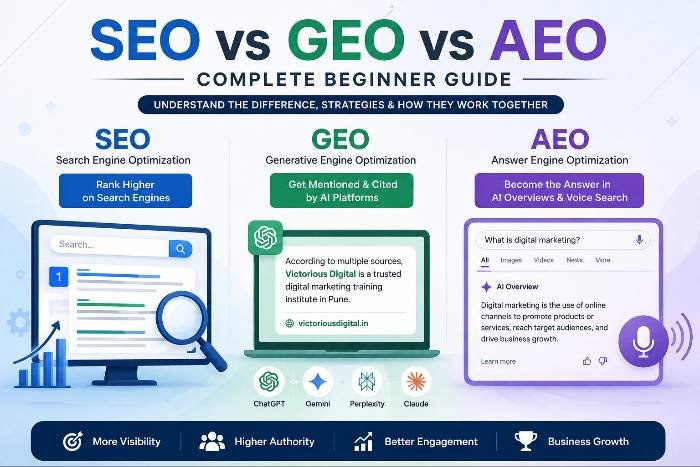
The good news? The good news? SEO is not dead. It has just changed. Businesses that use SEO, AEO, and GEO together are getting noticed on both search engines and AI-powered platforms. Recent research shows that AI search is quickly changing how people find information, so brands need to optimise beyond just traditional rankings.SEO (Search Engine Optimisation) is the process of improving a website so that it ranks higher in search engines like Google and Bing. The objective is simple: increase organic traffic by making your content relevant, trustworthy, and technically optimised.
Traditional SEO focuses on finding the right keywords, creating good content, getting links from other sites, fast website speed, mobile-friendly design, user experience, and technical fixes. When someone searches for “Digital Marketing Course in Pune,” Google looks at many factors before showing the most relevant pages.
Table of Contents
Benefits of SEO
- Higher organic traffic
- Better brand visibility
- Long-term lead generation
- Increased website authority
- Improved user experience. SEO is still the base of online visibility because AI systems often get information from well-optimised, trusted websites.
What is AEO?
Answer Engine Optimisation (AEO) helps your content become the direct answer to a user’s question. Instead of just ranking on a search results page, AEO tries to show up in Featured Snippets, Google AI Overviews, voice assistants, and AI-generated answers.
AEO focuses on making clear, factual, and well-organised answers. Using FAQs, schema markup, question-based headings, and clearly arranged content helps search engines and AI assistants pick your content as the answer.
Why AEO Matters
Users now expect quick answers instead of clicking through many websites. Optimising for AEO helps your content get seen even when users don’t visit the usual search results page.
What is GEO?
Generative Engine Optimisation (GEO) means improving content so AI platforms like ChatGPT, Gemini, Claude, Copilot, and Perplexity mention, cite, or suggest your website or brand in their answers.
Unlike traditional SEO, GEO is less about rankings and more about being a trusted source of information. AI systems check content quality, accuracy, topic expertise, brand mentions, and trustworthiness from many sources before citing them.
Why GEO is Growing
As AI assistants become a main way people search, businesses need to be visible where these conversations happen. Experts suggest seeing GEO as a part of SEO, not a replacement.
SEO vs GEO vs AEO Comparison
| Feature | SEO | AEO | GEO |
|---|---|---|---|
| Primary Goal | Rank in search results | Become the direct answer | Get cited by AI platforms |
| Platforms | Google, Bing | Google AI Overviews, Voice Search | ChatGPT, Gemini, Claude, Perplexity |
| Focus | Keywords & rankings | Questions & answers | Authority & AI citations |
| Success Metric | Organic traffic | Answer visibility | AI mentions and citations |
| Content Style | Comprehensive pages | Concise answers | Authoritative, trusted content |
The three strategies complement one another rather than compete.
How AI Search Has Changed User Behaviour
Today’s users ask full questions instead of just typing short keywords. Questions like “Which is the best digital marketing course in Pune?” are often answered directly by AI.
This means businesses need content that is:
- Easy to understand
- Factually accurate
- Well-structured
- Regularly updated
- Supported by expertise and trustworthy sources
Recent studies show that AI-generated answers are changing how people click, making it more important for marketers to focus on answer visibility.
Best Practices for SEO
Technical SEO
A technically well-built website is easier for search engines to read and understand.
Focus on:
- Fast page speed
- Mobile responsiveness
- HTTPS security
- XML sitemaps
- Internal linking
- Core Web Vitals
Content SEO
Create detailed content that matches what users are looking for.
Best practices include:
- Target one primary keyword
- Use related keywords naturally.
- Write helpful, original content.
- Add images with descriptive alt text.
- Update content regularly
Best Practices for AEO
To improve Answer Engine Optimisation:
- Answer questions clearly.
- Add FAQ sections.
- Use structured headings.
- Add FAQ and How-To structured data.
- Keep answers concise while supporting them with detailed explanations.
- Write in natural language suitable for voice search.
These techniques improve the likelihood that AI systems can extract your content accurately.
Best Practices for GEO
Generative AI platforms prefer trustworthy information.
Improve GEO by:
- Publishing original research.
- Building topical authority.
- Earning mentions on reputable websites.
- Keeping facts current.
- Using consistent brand and entity information.
- Including expert authorship and citations where appropriate.
Think of GEO as building a reputation across the web rather than optimising a single page.
Common Mistakes to Avoid
Many businesses still make avoidable mistakes, including:
- Writing only for keywords instead of users.
- Ignoring structured data.
- Publishing outdated information.
- Creating thin AI-generated articles without adding expertise.
- Neglecting technical SEO.
- Forgetting to build brand authority outside their own website.
Avoiding these mistakes improves visibility across search engines and AI platforms.
Future of Search in 2026
Search is becoming a combination of traditional rankings and AI-generated answers. Google, Bing, ChatGPT, Gemini, and Perplexity increasingly prioritise trustworthy, well-structured, and authoritative information.
Instead of choosing between SEO, AEO, and GEO, businesses should integrate all three. SEO builds discoverability, AEO improves answer visibility, and GEO increases the likelihood of being cited by AI systems. Organisations that invest in high-quality content, technical excellence, and strong brand authority will be best positioned as AI-assisted search continues to evolve.
Conclusion
The future of digital marketing isn’t about replacing SEO with AEO or GEO. It’s about combining all three strategies into one unified approach. SEO helps users discover your website through traditional search. AEO ensures your content becomes the best answer for search engines and voice assistants. GEO positions your brand as a trusted source for AI-generated responses across platforms like ChatGPT and Gemini.
Businesses that adapt early will gain greater visibility, stronger authority, and more opportunities to reach users wherever they search. If you’re starting today, build a technically sound website, publish genuinely helpful content, answer user questions clearly, and establish your brand as an authoritative entity across the web.
FAQs
1. Is SEO still important in 2026?
Yes. SEO remains the foundation for online visibility and supports both AEO and GEO efforts.
2. What is the biggest difference between SEO and GEO?
SEO focuses on ranking web pages, while GEO focuses on being cited and recommended in AI-generated responses.
3. Is AEO the same as GEO?
No. AEO optimises for direct answers such as featured snippets and AI summaries, while GEO focuses on visibility across generative AI platforms.
4. Can a business use SEO, AEO, and GEO together?
Absolutely. The most effective strategy combines all three to maximise visibility across search engines and AI assistants.
5. Which strategy should beginners start with?
Begin with strong SEO fundamentals, then enhance your content for AEO and GEO as your website grows in authority.
Also Read – Hybrid Learning in Digital Marketing | Benefits & Practical Exposure