How Search Engines Are Changing Digital Marketing Rules?
Table of Contents
The Evolution of Search Engines
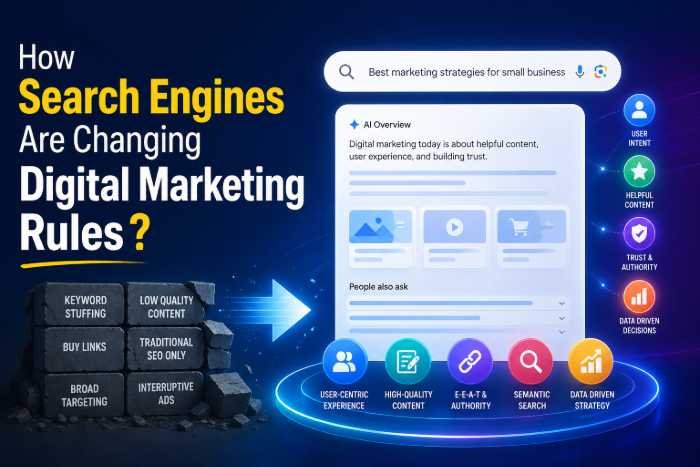
Search engines didn’t always feel as intuitive as they do today. If you rewind to the early 2000s, ranking on Google was largely about stuffing the right keywords into your content and building as many backlinks as possible. It was almost mechanical—like cracking a code rather than understanding a human. But that approach no longer works, and honestly, it feels outdated in a world where search engines are becoming more like thinking assistants than simple tools.
Today’s search engines are powered by complex AI systems that interpret context, behavior, and intent. Google’s algorithms—like RankBrain, BERT, and MUM—have shifted the focus away from exact keyword matches toward understanding what users actually mean. This means digital marketing is no longer just about visibility; it’s about relevance and usefulness.
From Keyword Matching to Intent Understanding
There was a time when repeating a keyword multiple times could almost guarantee a higher ranking. That tactic now feels like trying to win a chess game by repeating the same move over and over—it just doesn’t work anymore. Search engines have grown smarter, and they’re now focused on interpreting what users actually want, not just what they type.
User intent is the driving force behind modern SEO. For example, when someone searches “best laptops for students,” they’re not looking for a definition of laptops—they want recommendations, comparisons, and maybe even pricing insights. Search engines recognize this and prioritize content that delivers exactly that.
The Rise of AI in Search Algorithms
Artificial intelligence is no longer a buzzword—it’s the backbone of modern search engines. Google processes billions of searches daily, and AI helps interpret these queries with incredible precision. Algorithms like BERT and MUM analyze language in a way that feels almost human, understanding nuance, tone, and context.
This has massive implications for digital marketing. AI doesn’t just rank content based on keywords; it evaluates how well your content aligns with user expectations. It looks at engagement signals, content depth, and even credibility factors.
One major shift is how AI handles ambiguous queries. If someone searches for “apple,” the algorithm determines whether they mean the fruit or the tech company based on context and user behavior. That level of sophistication means marketers need to be crystal clear in their messaging.
The Shift from Keywords to Search Intent
Digital marketing used to revolve around keywords like planets orbiting the sun. Now, search intent has taken that central role, and everything else revolves around it. This shift is not just technical—it’s psychological. It’s about understanding how people think, what they need, and how they express those needs through search queries.
Search intent can generally be categorized into informational, navigational, transactional, and commercial investigation. Each type requires a different content approach. For instance, someone searching “how to start a blog” expects a step-by-step guide, while someone searching “best blogging platforms” is likely comparing options before making a decision.
Why User Intent Matters More Than Ever
User intent has become the heartbeat of modern SEO, and ignoring it is like trying to navigate without a compass. Search engines are now designed to prioritize content that satisfies user needs quickly and effectively. This means your content must not only attract clicks but also deliver value immediately.
One reason intent matters so much is competition. With millions of pages competing for attention, search engines need a reliable way to determine which content deserves the top spot. User satisfaction metrics—like dwell time and bounce rate—play a crucial role here.
Another factor is the rise of AI-generated summaries and featured snippets. These features aim to answer user queries directly on the search results page. If your content doesn’t align with intent, it won’t be selected for these prime positions.
Types of Search Intent Marketers Must Know
To truly master modern SEO, you need to recognize the different types of search intent and tailor your content accordingly. Think of it as speaking different dialects of the same language—each one requires a slightly different approach.
Informational intent is the most common. Users are looking for answers, explanations, or insights. Content like blog posts, tutorials, and guides works best here. The goal is to educate and provide value without pushing a sale.
Navigational intent is more straightforward. Users are trying to find a specific website or page. In this case, strong branding and clear site structure are essential.
AI-Powered Search and Its Impact
The integration of artificial intelligence into search engines hasn’t just tweaked the rules of digital marketing—it has rewritten the entire playbook. What used to be a relatively predictable system of rankings and keywords has transformed into a dynamic ecosystem driven by machine learning, behavioral data, and real-time context. Today, search engines don’t just respond; they anticipate. And for marketers, that shift demands a deeper level of strategy, creativity, and adaptability.
AI-powered search is designed to deliver faster, more accurate, and more personalized results. Google alone processes over 8.5 billion searches per day, and a significant portion of those queries are now handled using AI models that interpret meaning rather than just words. This means your content is no longer judged solely on technical SEO factors—it’s evaluated based on how well it aligns with user expectations, intent, and engagement.
Google AI Overviews and Generative Search
Google’s introduction of AI Overviews (formerly part of Search Generative Experience) marks a turning point in how users interact with search results. Instead of showing a list of links, Google now provides summarized answers directly at the top of the page, often pulling information from multiple sources. It’s like having a mini-article generated instantly in response to your query.
This changes user behavior significantly. Many users find what they need without clicking on any links, leading to a rise in zero-click searches, which now account for more than 50% of all Google queries according to recent studies. That’s a huge shift for marketers who rely on organic traffic.
How ChatGPT and AI Tools Influence SEO
AI tools like ChatGPT, Gemini, and other conversational platforms are reshaping how people search for information. Instead of typing fragmented queries into a search bar, users are increasingly asking full questions and expecting detailed, conversational answers. This shift is pushing SEO toward a more natural, human-centered approach.
Think about it—when someone asks an AI tool, “What’s the best way to improve my website’s SEO in 2026?” they expect a comprehensive answer, not a list of links. This changes how content should be written. It needs to be engaging, informative, and structured in a way that answers questions directly.
Content Quality Over Quantity
There was a time when publishing large volumes of content could boost your rankings. That strategy doesn’t hold up anymore. Today, search engines prioritize quality over quantity, and the definition of quality has become more sophisticated.
High-quality content isn’t just well-written—it’s useful, accurate, and trustworthy. It answers questions thoroughly, provides actionable insights, and keeps users engaged. Search engines measure this through various signals, including time spent on page, click-through rates, and user interactions.
One key reason for this shift is the sheer volume of content available online. With millions of new pages published every day, search engines need a way to filter out noise. Quality becomes the deciding factor.
E-E-A-T Principles Explained
Google’s E-E-A-T framework—Experience, Expertise, Authoritativeness, and Trustworthiness—has become a cornerstone of modern SEO. It’s essentially a way for search engines to evaluate the credibility of your content.
- Experience refers to firsthand knowledge or real-world involvement.
- Expertise measures the depth of knowledge on a topic.
- Authoritativeness reflects your reputation within your industry.
Voice Search and Conversational Queries
Voice search is no longer a futuristic concept—it’s part of everyday life. With the rise of smart speakers, smartphones, and virtual assistants, more people are using voice commands to find information online. In fact, studies suggest that over 40% of adults use voice search daily.
This shift has a significant impact on digital marketing. Voice searches tend to be longer and more conversational than text-based queries. Instead of typing “best pizza NYC,” a user might say, “What’s the best pizza place near me right now?”
The Growth of Voice Assistants
Devices like Alexa, Google Assistant, and Siri have become integral to how people interact with technology. They’re fast, convenient, and hands-free, making them ideal for on-the-go searches.
For marketers, this means optimizing for local and conversational queries. Many voice searches are location-based, which makes local SEO more important than ever.
Another interesting aspect is how voice assistants deliver results. They often provide a single answer rather than a list of options. This creates a winner-takes-all scenario, where only the top result gets visibility.
Optimizing for Natural Language Searches
To succeed in voice search, content needs to sound natural and conversational. This includes using question-based headings, simple language, and clear answers.
Structured data can also help search engines understand your content better. By providing context, you increase the chances of your content being selected as a voice search result.
Mobile-First and User Experience Signals
The majority of web traffic now comes from mobile devices, and search engines have adapted accordingly. Google’s mobile-first indexing means that the mobile version of your site is considered the primary version for ranking purposes.
User experience (UX) plays a crucial role here. Factors like page speed, navigation, and design directly impact how users interact with your site.
Core Web Vitals and Ranking Factors
Core Web Vitals measure key aspects of user experience, including loading speed, interactivity, and visual stability. These metrics are now part of Google’s ranking algorithm.
Improving these factors can significantly boost your SEO performance. It’s not just about content anymore—it’s about how that content is delivered.
UX as a Competitive Advantage
A well-designed website can set you apart from competitors. If users find your site easy to navigate and engaging, they’re more likely to stay longer and explore further.
Zero-Click Searches and Featured Snippets
If you’ve noticed your website traffic behaving strangely lately—even when your rankings look solid—you’re not imagining things. The rise of zero-click searches has quietly reshaped how users interact with search engines. In simple terms, a zero-click search happens when users get the answer they need directly on the results page without ever clicking through to a website. It’s fast, efficient, and from a user perspective, incredibly convenient. But for digital marketers, it introduces a whole new layer of complexity.
Recent data suggests that over 50–60% of Google searches end without a click, largely due to features like featured snippets, knowledge panels, AI overviews, and instant answers. This means that even if your content ranks on page one, it might not receive the traffic you expect. That’s a big shift from the traditional SEO model where ranking high almost guaranteed visibility and clicks.
Personalized Search Results
Even as privacy restrictions increase, personalization remains a key feature of modern search engines. Results are tailored based on factors like location, search history, and user preferences. This means no two users see exactly the same results for the same query.
For marketers, this creates both challenges and opportunities. Ranking becomes less predictable, but it also allows for more targeted strategies. By understanding your audience segments, you can create content that resonates with specific groups.
Personalization also emphasizes the importance of local SEO. For example, a search for “best coffee shop” will yield different results depending on the user’s location. This makes optimizing for local keywords and maintaining accurate business listings essential.
Conclusion and Key Takeaways
Search engines are no longer just tools—they’re intelligent systems that shape how information is discovered, consumed, and trusted. From AI-driven algorithms to zero-click searches and voice queries, the rules of digital marketing are evolving at a rapid pace.
The core takeaway is this: focus on the user. Everything else—keywords, algorithms, rankings—follows from that. When your content genuinely helps people, aligns with their intent, and delivers a great experience, search engines take notice.
Success in this new landscape requires a balance of technical knowledge and human insight. It’s about understanding both the algorithm and the audience—and creating content that satisfies both.
FAQs
1. How are search engines changing SEO strategies?
Search engines are shifting focus from keywords to user intent, content quality, and user experience. AI and personalization play a major role in determining rankings.
2. What is a zero-click search?
A zero-click search occurs when users get answers directly on the search results page without clicking on any links.
3. Why is user intent important in digital marketing?
User intent helps ensure that content matches what users are actually looking for, improving engagement and conversion rates.
4. How does AI impact search engine rankings?
AI analyzes context, behavior, and content quality to deliver more relevant results, making SEO more dynamic and complex.
5. What is the future of search engines?
The future includes predictive search, voice and visual queries, and more personalized, AI-driven experiences.
Read Also : How to Monetize Your Blog as a Digital Marketing Professional?