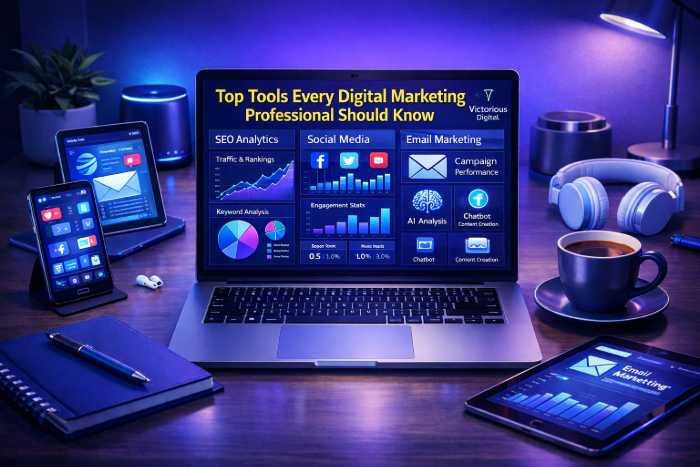
Top Tools Every Digital Marketing Professional Should Know
Table of Contents
Introduction: Why Digital Marketing Tools Matter More Than Ever
If digital marketing were a battlefield, tools would be your armor, weapons, and strategy map all rolled into one. Gone are the days when marketers relied purely on gut instinct and creativity. Today, success lives at the intersection of data, automation, creativity, and speed. Digital marketing tools are no longer “nice to have”—they’re essential survival gear.
Think about it. You’re juggling SEO, content creation, social media, paid ads, email campaigns, analytics, and reporting—all while trying to prove ROI. Without the right tools, that workload becomes overwhelming fast. With the right tools, however, you can work smarter, not harder; automate repetitive tasks; uncover hidden insights; and scale campaigns efficiently.
What makes this even more important is the rapid pace of change in the digital landscape. Algorithms update, consumer behavior shifts, and platforms evolve overnight. Tools help marketers stay agile, adapt quickly, and make data-backed decisions rather than emotional guesses. They’re like a GPS in a constantly changing city—you might still reach your destination without one, but you’ll waste time, energy, and money along the way.
In this guide, we’ll walk through the top tools every digital marketing professional should know. Whether you’re a beginner trying to break into the industry or a seasoned marketer looking to sharpen your edge, this blog will give you a practical, real-world understanding of the tools that actually move the needle.
Note: Join Our Digital Marketing Courses for Practical Training
The Digital Tool Ecosystem of The Digital Marketing Landscape
Now, before we jump to any particular tool, let us have an idea of the ecosystem these tools live in because digital marketing tools are never an island, and they work best as a part of a connected system. The different categories support each stage of the customer journey from awareness to conversion to retention.
Digital marketing tools can be categorized into their own areas , like SEO, content, social media, email, paid advertising, analytics, CRO, CRM, automation, design, and project management. Individually, they each tackle a particular problem, but collectively, they form an unstoppable force for your marketing engine.
SEO tools help you get the traffic, content tools help you engage the traffic, CRO tools help you convert it, CRM tools help you manage the relationship, and analytics tools help you see what’s working and what’s not. When integrated properly, your data moves without friction, and you have a complete picture of your marketing funnel.
But one more advantage of the right tools is getting things done faster. Automation is where tools do the work on your behalf — this means you no longer spend hours on manual tasks associated with report generation, posting, or tracking keywords. What it does is get your hands free so that you can touch strategy, creativity, and experiment — the things where humans beat all machines ever made.
This ecosystem knowledge allows you to avoid the pitfalls of a class of common mistakes: tool overload. Having more tools doesn’t necessarily lead to better outcomes. Getting it down to a lean integrated stack, as per your requirements, budget, and team size.
SEO Tools: The Fundamentals of Organic Growth
SEO is the long game of the digital marketing world, but without the right tools, it’s like playing chess with a blindfold. Tools for SEO provide insight into what people are doing with their queries, how well your site performs, and where the points of pain reside.
First, we look to keyword research tools. These tools assist you in comprehending search intent, discovering high-volume keywords, and locating low-competition opportunities. These tools are also not merely keyword generators → they provide insights into trends, seasonality, and user intent. That shows you how to write content that actually answers people’s questions.
And that is where technical SEO tools come in. They scan your website similarly to how search engines do, finding problems such as broken links, low page speed, recycled content, and a lack of mobile optimization. This is often a big fix to foil rankings without the need to create a sole new piece of content.
Those rank tracking and competitor analysis tools will keep track of the scores for you. Keep watch on your keyword performance over time, as well as what competition is ranking for, so you can reverse engineer their tactics. Its like a looking glass into your competitors’ playbook.
SEO tools are a must-have for digital marketers. They replace guesswork with strategy and unpredictability with predictability when it comes to organic growth.
Content Marketing Tools: Fuel for Engagement
Content is the heartbeat of digital marketing. But creating high-quality, consistent content without tools is exhausting. Content marketing tools help you ideate, create, optimize, and manage content efficiently.
Content ideation tools are lifesavers when you hit writer’s block. They analyze search queries, trending topics, and audience interests to suggest ideas that people actually care about. Instead of guessing what to write, you’re guided by data.
Content optimization tools focus on readability, structure, keyword usage, and semantic relevance. They act like a virtual editor, ensuring your content is not only engaging for humans but also optimized for search engines. These tools help balance creativity with SEO—a balance many marketers struggle with.
Content planning and collaboration platforms bring order to chaos. Editorial calendars, task assignments, version control, and collaboration features keep teams aligned. Everyone knows what’s being published, when it’s going live, and who’s responsible.
For marketers, content tools don’t replace creativity—they amplify it. They remove friction from the process so you can focus on storytelling and value creation.
Note: Join Our Digital Marketing Courses in Pune with Placement for Practical Training
Social Media Marketing Tools: Managing the Noise
Social media can feel like shouting into a crowded room. Social media marketing tools help you cut through the noise with consistency, data, and strategy.
Scheduling and automation tools allow you to plan posts across multiple platforms. This ensures a consistent presence without being glued to your phone 24/7. It also allows you to post at optimal times based on audience behavior.
Social listening tools take things deeper. They track brand mentions, hashtags, keywords, and competitor activity. This helps you understand what people are saying about your brand and industry in real time. It’s like having your ear to the digital ground.
Analytics tools measure engagement, reach, clicks, and conversions. Instead of chasing vanity metrics, you can focus on what actually drives business results. Influencer marketing platforms also help identify creators who align with your brand, manage collaborations, and measure ROI.
For digital marketers, social media tools transform chaos into clarity.
Email Marketing Tools: Still the King of ROI
Despite all the hype around new channels, email marketing remains one of the highest ROI strategies in digital marketing. Email tools make it scalable, personalized, and measurable.
Email campaign management tools help design, send, and manage campaigns. Drag-and-drop editors make design accessible, while templates ensure brand consistency. List segmentation allows you to send the right message to the right audience.
Marketing automation tools take email to the next level. You can set up workflows triggered by user behavior—welcome emails, abandoned cart reminders, re-engagement campaigns, and more. This creates a personalized experience at scale.
Analytics and A/B testing tools show what works and what doesn’t. Subject lines, send times, content formats—everything can be tested and optimized. Email tools turn communication into a science rather than an art.
Pay-Per-Click (PPC) and Advertising Tools
Paid advertising is where budgets can vanish fast if you’re not careful. PPC tools help you spend smarter, not more.
Search advertising tools help manage keyword bids, ad copy, and extensions. Social advertising platforms allow granular targeting based on demographics, interests, and behavior. Optimization tools analyze performance and suggest improvements.
These tools help you identify high-performing ads, eliminate wasted spend, and scale winning campaigns. For digital marketers, PPC tools provide control in an otherwise volatile space.
Analytics and Data Tracking Tools: Measuring What Matters
Data is only powerful if you understand it. Analytics tools turn raw numbers into actionable insights.
Web analytics tools track traffic sources, user behavior, and conversions. Funnel analysis tools show where users drop off and why. Heatmaps visualize how users interact with pages, revealing usability issues you might never notice otherwise.
These tools answer critical questions: What’s working? What’s not? Where should you invest more? Without analytics, marketing becomes expensive guesswork.
Conversion Rate Optimization (CRO) Tools
Getting traffic is hard. Converting it is harder. CRO tools focus on making the most of the traffic you already have.
A/B testing tools allow you to test variations of pages, headlines, CTAs, and designs. Landing page builders make it easy to create high-converting pages without developers. User feedback tools capture real insights straight from visitors.
CRO tools help marketers think like users, not just advertisers.
Customer Relationship Management (CRM) Tools
CRM tools bridge the gap between marketing and sales. They centralize customer data, track interactions, and manage leads.
Modern CRMs integrate with email, social media, ads, and websites. This creates a unified view of each customer. Reporting features help measure lifetime value, conversion rates, and campaign performance.
For digital marketers, CRM tools turn leads into relationships.
Marketing Automation Tools: Scaling Smartly
Automation tools are the secret weapon of high-performing marketing teams. They handle repetitive tasks while maintaining personalization.
From lead scoring to multi-channel workflows, automation tools help nurture prospects efficiently. Omnichannel platforms ensure consistent messaging across email, social, SMS, and web.
Automation doesn’t replace human strategy—it amplifies it.
Note: Join Our Digital Marketing Certification Training Program for Practical Training
Design and Creative Tools for Marketers
Visuals matter. Design tools empower marketers to create professional graphics, videos, and presentations without design degrees.
Video tools support editing, captions, and animations. Brand asset management tools keep logos, fonts, and templates organized. These tools protect brand consistency while boosting creativity.
Project Management and Collaboration Tools
Marketing is a team sport. Project management tools keep everyone aligned.
Task tracking, timelines, file sharing, and communication features reduce confusion and missed deadlines. Time tracking tools improve productivity and accountability.
For digital marketers, these tools keep chaos under control.
AI and Emerging Tools in Digital Marketing
AI is reshaping digital marketing. AI-powered tools assist with copywriting, SEO insights, predictive analytics, and chatbots.
These tools analyze massive datasets quickly, identify patterns, and suggest optimizations. Chatbots improve customer support and lead generation. AI doesn’t replace marketers—it makes them more powerful.
How to Choose the Right Digital Marketing Tools
Choosing tools isn’t about trends—it’s about fit. Consider budget, features, scalability, and integrations. Ease of use matters more than flashy features. Start small, test, and scale.
Mistakes in Using Digital Marketing Tools
Well, what tool overload, bad (non)-integration, do not listen to the data, and too much automation are the most common pitfalls. The best construction tools are effective only if there is a strategy behind them.
Future of Digital Marketing Tools
Smart — Faster — More Connected — The Future, and expect even more AI, along with improved personalization and deeper analytics. Marketers who adapt will thrive.
Conclusion
Digital marketing tools are the engine behind modern marketing success. They bring clarity, efficiency, and scalability to complex processes. Mastering these tools isn’t optional—it’s essential. The right stack empowers you to create better experiences, make smarter decisions, and drive real business growth.
Also Read: – A Day in the Life of a 2026 Digital Marketing Specialist