The Latest AI Tools Transforming Work, Creativity, & Productivity in 2026
Artificial intelligence is no longer some futuristic concept confined to research labs or sci-fi movies. It has quietly woven itself into everyday work, creativity, and even personal productivity. From writing articles and generating stunning artwork to editing videos and automating entire workflows, AI tools have become the invisible engines powering modern digital life. Businesses, freelancers, students, and creators are all discovering how these technologies can dramatically reduce time spent on repetitive tasks while unlocking entirely new possibilities.
The speed at which AI innovation is happening right now is staggering. Just a few years ago, tools capable of writing long-form content, generating photorealistic images from text prompts, or assisting developers with complex code were rare. Today, dozens of sophisticated platforms offer these capabilities with surprising accuracy and creativity. According to industry reports, the global AI market is expected to exceed $1.8 trillion by 2030, reflecting how deeply these technologies are shaping industries ranging from marketing to healthcare.
One reason AI tools are exploding in popularity is accessibility. You no longer need a background in machine learning or programming to use them. Many modern platforms operate through simple prompts, drag-and-drop interfaces, or chat-style interactions. In other words, if you can type a sentence or describe an idea, you can harness powerful AI to bring it to life.
Another factor is productivity. Imagine writing a blog post draft in minutes, generating social media visuals instantly, or having an AI assistant summarize long reports. For professionals juggling multiple tasks, AI tools function like digital teammates that work 24/7 without fatigue.
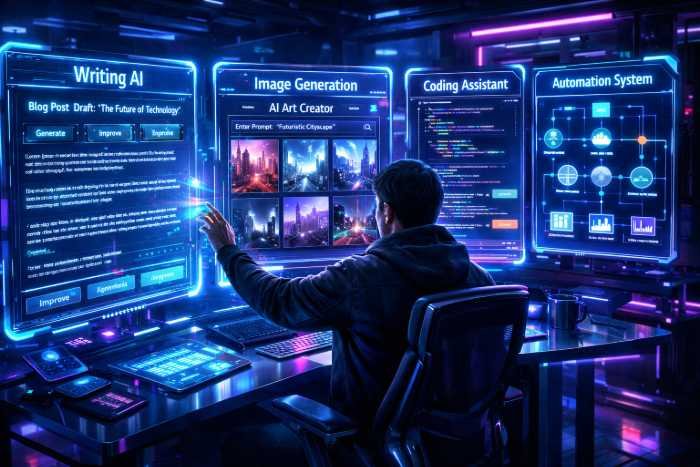
This article explores the latest AI tools dominating the tech landscape in 2026. You’ll discover tools designed for writing, design, video production, automation, and software development. Whether you’re a content creator, entrepreneur, developer, or simply curious about the future of technology, understanding these tools can give you a significant advantage in the digital age.
Note: Learn Latest AI Tool – Join Our AI Powered Digital Marketing Courses
Table of Contents
The Rapid Evolution of Artificial Intelligence Tools
Artificial intelligence has evolved at an astonishing pace over the last decade, transforming from a niche research field into a mainstream technology powering thousands of applications. The tools we see today represent the culmination of breakthroughs in machine learning, deep learning, natural language processing, and generative AI. These advancements have enabled computers not just to analyze data but also to create content, solve complex problems, and interact with humans in surprisingly natural ways.
A major turning point came with the rise of large language models (LLMs) and advanced neural networks. These models are trained on massive datasets containing text, images, videos, and code. Through this training, AI systems learn patterns and relationships, allowing them to generate meaningful responses or creative outputs when given a prompt. What once required teams of engineers can now be achieved through a simple chat interface.
Another reason AI tools have evolved so rapidly is the increase in computing power. Cloud platforms and specialized hardware such as GPUs have made it possible to train extremely large models. Companies like OpenAI, Google, Meta, and Anthropic are investing billions of dollars in AI research, pushing the boundaries of what these tools can accomplish.
The rise of API-based AI services has also accelerated innovation. Developers no longer need to build AI models from scratch; they can integrate existing AI capabilities directly into their apps. This approach has led to an explosion of startups creating niche AI tools for writing, marketing, coding, design, and data analysis.
What makes this evolution particularly fascinating is how quickly these tools are improving. Early AI-generated content often sounded robotic or inaccurate. Today, many AI systems can produce human-like writing, realistic images, and sophisticated code with minimal guidance.
The real impact of AI tools isn’t just technological—it’s cultural. They are reshaping how people work, learn, and create. Students use AI tutors, marketers rely on AI content generators, and developers collaborate with AI coding assistants. In many workplaces, AI is becoming as essential as email or spreadsheets.
Understanding this rapid evolution helps explain why new AI tools appear almost every month. The technology is moving forward at a pace rarely seen in the history of computing, making it one of the most exciting areas of innovation today.
Why AI Tools Are Growing Faster Than Ever
The explosive growth of AI tools isn’t happening by accident. Several powerful forces are converging at the same time, creating the perfect environment for rapid innovation. Advances in machine learning research, increased access to computing resources, and massive investment from tech giants have all contributed to a technology boom that is reshaping industries around the world.
One of the biggest drivers behind this growth is data availability. Modern AI systems rely on enormous datasets to learn patterns and make predictions. With the internet generating staggering amounts of information every day—text, images, videos, and behavioral data—AI models have more training material than ever before. This abundance of data allows systems to become more accurate and versatile.
Another factor is venture capital and corporate investment. Tech companies are racing to develop the most advanced AI models because the potential economic impact is enormous. According to estimates from McKinsey, generative AI alone could add $2.6 to $4.4 trillion annually to the global economy. With numbers like that, it’s no surprise that startups and major corporations are pouring resources into AI development.
Accessibility also plays a major role. In the past, using AI often required advanced technical knowledge. Today, many tools feature simple interfaces that allow anyone to interact with sophisticated algorithms. A marketer can generate ad copy with a prompt, a designer can create images with a short description, and a developer can receive coding suggestions in real time.
The rise of remote work and digital businesses has further accelerated adoption. Companies are constantly looking for ways to increase efficiency, and AI tools offer a clear solution. Tasks that once required hours of manual work—like summarizing documents or editing videos—can now be completed in minutes.
There is also a strong network effect in play. As more people use AI tools, they provide feedback and data that help improve the systems. This creates a continuous loop of improvement where tools become smarter, more accurate, and more capable over time.
The result is a rapidly expanding ecosystem of AI solutions. New platforms appear almost weekly, each promising to streamline workflows, enhance creativity, or automate complex processes. For individuals and businesses willing to embrace these technologies, the opportunities are enormous.
The Role of Generative AI in Everyday Workflows
Generative AI has quickly become the beating heart of the modern AI revolution. Unlike traditional AI systems that focus mainly on analyzing data or making predictions, generative AI is designed to create entirely new content. Whether it’s writing articles, generating images, composing music, designing websites, or producing videos, generative AI tools are redefining what machines can do. In many ways, these systems act like creative partners rather than simple automation tools.
One reason generative AI is becoming so deeply embedded in everyday workflows is its ability to dramatically reduce the time required to complete complex tasks. Think about a marketing professional who needs to produce blog posts, social media captions, and advertising copy every week. Traditionally, this process could take hours of brainstorming and editing. With generative AI tools, the first draft can appear in seconds, allowing the human creator to focus on refining ideas rather than starting from scratch.
Businesses are also integrating generative AI into internal operations. Customer service teams use AI chatbots to respond to common questions instantly. Sales teams rely on AI tools to generate personalized email campaigns. Designers use AI image generators to explore creative concepts before finalizing visuals. In many organizations, AI acts like a productivity multiplier, enabling smaller teams to achieve much larger outputs.
The educational sector is experiencing similar transformations. Students now use generative AI tools to help summarize complex research papers, generate study notes, or brainstorm essay ideas. Teachers use AI to create lesson plans, quizzes, and educational content tailored to different learning levels. Instead of replacing human expertise, these systems often function as intelligent assistants that enhance the learning process.
Another fascinating aspect of generative AI is how it encourages experimentation. Because AI can produce ideas so quickly, users are more willing to test different approaches. A content creator might generate ten headline options instead of struggling with one. A designer can experiment with dozens of visual styles before choosing the best concept. This rapid iteration often leads to more innovative results.
As generative AI continues evolving, its role in everyday workflows will likely expand even further. Tools are already becoming capable of combining multiple abilities—writing text, generating images, analyzing data, and automating tasks within the same platform. The result is a new generation of AI-powered creative environments where humans and machines collaborate seamlessly.
Note: Join Our Digital Marketing Classes in Pune for Practical Training
AI Writing and Content Creation Tools
The rise of digital media has created an enormous demand for content. Businesses need blog posts, newsletters, product descriptions, social media updates, and marketing campaigns constantly. This demand has led to the rapid development of AI writing tools designed to assist content creators and marketers. These platforms use advanced natural language processing models to generate text that often feels surprisingly human.
One of the biggest advantages of AI writing tools is speed. What once took hours of drafting and editing can now begin with a simple prompt. Writers can describe the topic, tone, and audience, and the AI generates structured content within seconds. This doesn’t mean the human writer becomes unnecessary; instead, AI provides a starting point that can be refined, expanded, and personalized.
Another key benefit is idea generation. Many writers face the challenge of staring at a blank page, unsure where to start. AI writing tools can instantly generate outlines, headline ideas, and content drafts, helping creators overcome writer’s block. For bloggers, marketers, and entrepreneurs managing multiple projects, this capability is incredibly valuable.
These tools also help optimize content for search engine optimization (SEO). Modern AI writing platforms can analyze keywords, suggest headings, and structure content in ways that improve visibility on search engines. By combining writing assistance with SEO insights, AI tools allow creators to produce content that is both engaging for readers and optimized for online discovery.
However, the real power of AI writing tools lies in collaboration. Instead of replacing human creativity, they act like brainstorming partners that can quickly explore different writing styles or angles. A writer might generate a formal version of an article, a conversational version, and a persuasive version within minutes.
As digital communication continues to grow, AI writing tools will likely become standard tools in many professions. Content marketers, journalists, educators, and even business executives are discovering that AI-assisted writing can significantly improve productivity without sacrificing creativity.
ChatGPT and the Rise of Conversational AI
One of the most recognizable AI tools in the world today is ChatGPT, a conversational AI platform that has transformed how people interact with machines. Instead of using complicated commands or programming languages, users simply type questions or prompts in natural language. The AI responds with detailed explanations, creative ideas, or problem-solving assistance, making advanced technology accessible to virtually anyone.
ChatGPT’s influence extends far beyond casual conversation. Many professionals use it as a productivity assistant for brainstorming ideas, drafting documents, summarizing information, or explaining complex topics. For example, a small business owner might use ChatGPT to draft marketing emails, while a student could rely on it to clarify difficult academic concepts.
The tool is also widely used in content creation workflows. Writers often use conversational AI to generate outlines, expand sections of articles, or experiment with different writing styles. Because the system can maintain context across multiple prompts, it allows users to refine ideas through an interactive dialogue rather than a one-time command.
Another reason conversational AI has become so popular is its adaptability. ChatGPT can assist in dozens of fields, including education, programming, marketing, customer support, and research. This versatility makes it one of the most flexible AI tools currently available.
Businesses are also incorporating conversational AI into their customer support systems. AI chatbots powered by similar technologies can answer common customer questions instantly, reducing the workload on human support teams. According to several industry studies, companies using AI chatbots can reduce support costs by up to 30% while improving response times.
Despite its impressive capabilities, conversational AI works best when used thoughtfully. Human oversight remains important, especially for fact-checking and ensuring the content aligns with brand voice or professional standards. When used responsibly, ChatGPT demonstrates how AI can become a powerful collaborator rather than just another piece of software.
Jasper AI for Marketing and Copywriting
Another widely recognized AI writing platform is Jasper AI, a tool specifically designed for marketing teams, copywriters, and businesses that need high-quality promotional content at scale. While many AI writing tools focus on general-purpose text generation, Jasper has built its reputation around helping companies produce persuasive marketing copy that converts readers into customers.
One of Jasper’s strongest advantages is its specialization in marketing frameworks. The platform includes templates for blog posts, product descriptions, social media ads, email campaigns, and landing page copy. Instead of starting with a blank prompt, users can select a template that guides the AI to produce content aligned with proven marketing strategies.
Jasper also integrates with SEO tools, allowing marketers to create content optimized for search engine rankings. By combining keyword insights with AI-generated writing, businesses can produce articles designed to attract organic traffic from search engines like Google. This capability has made Jasper particularly popular among digital marketing agencies and content-driven startups.
Brand consistency is another feature that sets Jasper apart. Companies can train the system to follow specific brand voice guidelines, ensuring that AI-generated content matches their messaging style. Whether a brand wants a friendly conversational tone or a more professional corporate voice, Jasper can adapt accordingly.
Collaboration features further enhance the platform’s usefulness. Marketing teams can work together within the same workspace, reviewing and editing AI-generated content before publishing. This helps maintain quality control while still benefiting from the speed and efficiency of automation.
For businesses producing large amounts of content—such as e-commerce stores with hundreds of product listings—AI tools like Jasper can significantly reduce workload. Instead of writing every description manually, teams can generate drafts quickly and focus on refining the messaging.
The growing popularity of Jasper illustrates how AI is reshaping digital marketing. Rather than replacing human creativity, these tools amplify it by handling repetitive tasks and freeing marketers to focus on strategy, storytelling, and audience engagement.
Key Features That Make AI Writing Tools Powerful
AI writing tools have gained massive popularity not just because they generate text quickly, but because they combine several powerful capabilities into a single platform. These features allow writers, marketers, and businesses to produce high-quality content more efficiently than ever before.
Some of the most impactful features include:
| Feature | Description | Benefit |
|---|---|---|
| Natural Language Generation | AI produces human-like sentences based on prompts | Saves time on drafting content |
| SEO Optimization | Keyword suggestions and content structure guidance | Improves search engine visibility |
| Tone Adjustment | Ability to change writing style or voice | Maintains brand consistency |
| Content Expansion | Expands short ideas into full paragraphs | Helps overcome writer’s block |
| Multilingual Support | ₹15000 – ₹40000 per month | ₹15000 – ₹40000 per month |
| All Digital Marketing Packages | Generates content in multiple languages | Expands global reach |
One of the most valuable aspects of these features is their ability to support creative collaboration. Instead of replacing writers, AI tools often act like brainstorming partners that generate new ideas and perspectives. A writer can quickly test different angles, tones, or storytelling approaches before choosing the most effective one.
Another advantage is scalability. Businesses producing hundreds of pieces of content each month—such as product descriptions or social media posts—can maintain consistency without dramatically increasing their workforce. AI tools help ensure that large volumes of content remain coherent and aligned with brand messaging.
Accuracy and customization have also improved significantly. Modern AI systems can follow detailed instructions about audience type, content length, tone, and structure. This flexibility allows users to generate content tailored for specific platforms like blogs, LinkedIn posts, newsletters, or online ads.
As these technologies continue to evolve, the capabilities of AI writing tools will likely expand even further. Future systems may combine writing, research, editing, and publishing automation into a single seamless workflow, turning AI into a complete content production assistant.
AI Image Generation Tools
Artificial intelligence has dramatically transformed the world of digital art and design. Just a few years ago, creating high-quality visuals required advanced design skills, expensive software, and countless hours of work. Today, AI image generation tools allow anyone to create professional-quality artwork simply by describing what they want in text. This shift has opened the doors of creativity to millions of people who may not have formal training in graphic design or illustration.
AI image generators work using deep learning models trained on millions or even billions of images. These systems learn patterns such as lighting, composition, color relationships, textures, and artistic styles. When a user enters a prompt—something like “a futuristic city at sunset in cyberpunk style”—the AI combines these learned patterns to produce entirely new images. The results can range from realistic photographs to surreal fantasy artwork.
These tools are widely used across industries. Marketing teams generate custom graphics for advertisements and social media. Game developers use AI-generated concepts to explore new environments and character designs. Content creators and bloggers use AI visuals to enhance articles and presentations without needing large design budgets. Even architects and interior designers experiment with AI-generated concepts to visualize design ideas quickly.
One of the biggest advantages of AI image generation tools is speed. A designer might spend hours creating a concept sketch, while AI can generate multiple variations within seconds. This allows creators to experiment with different visual styles and choose the best option for their project. Instead of limiting creativity, technology often expands it by encouraging rapid exploration of ideas.
Another important benefit is accessibility. Many AI image tools operate through simple web interfaces where users only need to type prompts and adjust a few settings. Some platforms even allow users to refine images by editing specific areas, changing styles, or adjusting lighting conditions.
As AI models continue improving, image generation tools are becoming more realistic and more controllable. The ability to generate visuals instantly is reshaping industries like advertising, entertainment, and digital publishing. In the near future, AI-assisted design may become as common as using photo editing software today, fundamentally changing how visual content is created.
Note: Join Our Digital Marketing Courses in PCMC for Practical Training
Midjourney for Artistic Image Creation
Among the many AI image generation tools available today, Midjourney has become particularly famous for its ability to create highly artistic and visually striking images. Unlike some AI platforms that focus primarily on realism, Midjourney excels at producing images with dramatic lighting, imaginative compositions, and unique artistic styles.
Artists and designers often use Midjourney as a creative exploration tool. By experimenting with different prompts, they can generate concept art for projects such as video games, films, book covers, and graphic novels. For example, a user might input a prompt like “ancient floating city in the clouds, fantasy style, golden sunset lighting”, and the AI will generate multiple interpretations of that idea.
One reason Midjourney stands out is its ability to interpret abstract or imaginative prompts. Many AI tools struggle with unusual creative requests, but Midjourney often produces images that feel almost cinematic. This makes it popular among digital artists who want inspiration or visual references for larger projects.
Another advantage of Midjourney is the strong community surrounding it. Users often share prompts, techniques, and creative workflows online, creating an ecosystem where people learn from each other. This collaborative culture has helped the platform grow rapidly and inspired countless creative experiments.
Midjourney is also widely used in branding and marketing design. Businesses looking for unique visual assets can generate custom artwork that stands out from typical stock images. Because the AI produces original visuals, companies can create distinctive brand identities without relying on generic graphics.
Despite its strengths, Midjourney still benefits from human direction. The best results usually come from carefully crafted prompts that specify details like color palettes, camera angles, artistic styles, or lighting effects. In this sense, using the tool effectively is almost like learning a new creative language.
As AI image technology continues evolving, tools like Midjourney demonstrate how artificial intelligence can enhance artistic expression rather than replace it. Many creators now see AI as a creative partner that expands imagination instead of limiting it.
DALL·E and the Future of Visual Creativity
Another groundbreaking AI image generation platform is DALL·E, known for its ability to create detailed and imaginative visuals directly from text descriptions. Developed using advanced deep learning models, DALL·E demonstrates how AI can transform simple written ideas into vivid visual representations.
One of the most impressive aspects of DALL·E is its versatility. The system can generate everything from realistic photography-style images to abstract illustrations and surreal art concepts. For example, a user could request “a watercolor painting of a robot reading a book in a quiet library”, and the AI will produce a unique image that matches the description.
DALL·E also introduced powerful image editing capabilities. Instead of generating images only from scratch, users can modify existing pictures by adding or replacing elements. If a designer has a photo but wants to change the background or add objects, DALL·E can intelligently fill in the new details while maintaining visual consistency.
These editing features are especially valuable for creative professionals. Designers can quickly prototype advertising visuals, social media graphics, or product mockups without spending hours in traditional editing software. For small businesses with limited resources, AI image tools like DALL·E provides access to design capabilities that were once expensive or time-consuming.
AI Video Creation and Editing Tools
Video content has become one of the most powerful forms of digital communication. Platforms like YouTube, TikTok, Instagram, and LinkedIn rely heavily on video to capture audience attention. However, traditional video production often requires expensive equipment, editing software, and significant technical expertise. This is where AI video creation tools are changing the game.
Modern AI video platforms can generate, edit, and enhance video content with minimal manual effort. These tools use machine learning algorithms to automate tasks such as cutting clips, adjusting colors, removing backgrounds, generating subtitles, and even creating entire videos from text scripts. What once required professional editing skills can now be done by beginners using intuitive interfaces.
Businesses are increasingly using AI video tools for marketing and communication. Instead of hiring large production teams, companies can produce product demos, training materials, and promotional videos quickly and affordably. This shift has made video marketing accessible to small businesses and independent creators.
Runway ML and AI Video Editing
One of the most exciting platforms in the AI video space is Runway ML, a tool that blends artificial intelligence with professional video editing capabilities. Over the past few years, Runway has become extremely popular among filmmakers, content creators, and digital artists who want to experiment with cutting-edge AI features without needing complex technical knowledge.
At its core, Runway ML focuses on simplifying tasks that traditionally required hours of manual editing. For example, removing a background from a video used to require painstaking frame-by-frame work. Runway’s AI-powered tools can now perform this process automatically within seconds. This capability is particularly valuable for creators producing content for platforms like YouTube, TikTok, or Instagram, where speed and efficiency are essential.
Another standout feature of Runway ML is text-to-video generation. With this technology, users can type a description of the scene they want—such as “a futuristic city skyline at night with flying cars”—and the AI will generate a short video clip that visually represents the prompt. While the results are still improving with each update, the potential for filmmakers and storytellers is enormous. Instead of spending weeks creating visual effects, creators can generate concept scenes instantly.
Synthesia for AI Avatar Videos
Another groundbreaking tool in the AI video ecosystem is Synthesia, a platform that specializes in creating videos featuring realistic AI-generated avatars. Instead of recording yourself on camera or hiring actors, Synthesia allows users to produce professional-looking videos simply by typing a script.
The platform works by combining text-to-speech technology with highly realistic digital avatars. Once the script is entered, the AI generates a video where the avatar speaks the text naturally, complete with synchronized lip movements and gestures. The result is a polished video presentation that looks like it was filmed in a professional studio.
Synthesia has become particularly popular for corporate training, educational content, and marketing presentations. Businesses can create training videos for employees without needing cameras, lighting setups, or production teams. This dramatically reduces both cost and production time.
One of Synthesia’s most powerful features is its multilingual capability. The platform supports dozens of languages, allowing companies to create the same video in multiple languages for global audiences. Instead of filming separate versions of a presentation, businesses can simply translate the script and generate a new AI avatar video instantly.
AI Productivity and Automation Tools
Artificial intelligence is not only transforming creative industries—it is also revolutionizing everyday productivity. Many professionals spend a significant portion of their workday on repetitive tasks such as organizing notes, managing schedules, analyzing documents, and coordinating workflows. AI productivity tools are designed to handle these tasks automatically, allowing people to focus on more strategic and creative work.
One major advantage of AI productivity platforms is their ability to integrate with multiple apps and services. Modern workplaces often rely on a mix of tools like email, project management software, calendars, and communication platforms. AI systems can connect these tools and automate interactions between them, reducing the need for manual data entry and repetitive actions.
For example, an AI productivity tool might automatically summarize meeting notes, generate follow-up emails, and update project management boards. Instead of switching between multiple apps and performing the same tasks repeatedly, employees can rely on AI to handle these routine processes.
Notion AI for Smart Workspaces
One of the most popular AI-powered productivity platforms today is Notion AI, an extension of the widely used Notion workspace platform. Notion itself is known for combining note-taking, project management, databases, and collaboration tools into a single workspace. With the addition of AI capabilities, the platform has become even more powerful.
Notion AI helps users generate, summarize, and organize information directly within their workspace. For example, if a user has a long meeting transcript, the AI can automatically summarize the key points and highlight important action items. This feature saves time and helps teams focus on the most important information.
Content creation is another area where Notion AI shines. Users can ask the AI to generate blog outlines, brainstorming ideas, marketing copy, or documentation directly inside their project pages. Because everything is stored within the same workspace, teams can collaborate on AI-generated content without switching between multiple tools.
Zapier AI for Workflow Automation
Automation has always been an important part of digital productivity, but Zapier AI has taken workflow automation to a new level. Zapier is widely known for connecting different apps and services so that actions in one platform can automatically trigger tasks in another. With the addition of AI features, the platform has become even more powerful and flexible.
Traditionally, creating automated workflows required users to define clear step-by-step rules. Zapier AI simplifies this process by allowing users to describe the workflow they want in natural language. For example, someone might type: “When I receive an email inquiry, create a task in my project manager and send a follow-up message.” The AI can automatically generate the workflow based on that description.
This capability makes automation accessible to people who may not have technical backgrounds. Small business owners, freelancers, and marketers can set up sophisticated automation systems without needing coding skills.
Zapier AI also integrates with thousands of applications, including email services, CRM platforms, project management tools, and e-commerce systems. This broad compatibility allows businesses to automate complex processes that involve multiple platforms.
The Future of AI Tools
The rapid rise of AI tools suggests that we are only at the beginning of a much larger technological transformation. Artificial intelligence is evolving at a pace rarely seen in the history of computing, and its impact will likely expand into nearly every industry. From healthcare and finance to entertainment and education, AI-driven systems are expected to become fundamental parts of everyday life.
One major trend shaping the future of AI tools is integration. Instead of using separate platforms for writing, design, video editing, and automation, many future tools will combine multiple capabilities into unified ecosystems. Imagine a single AI platform that can generate blog posts, create accompanying visuals, produce a promotional video, and automatically distribute the content across social media channels. This level of integration could dramatically simplify digital workflows.
Another important development is personalization. Future AI tools will likely adapt more closely to individual users, learning preferences, habits, and working styles. Over time, AI assistants may become deeply personalized collaborators that understand how each person thinks and works.
How AI Will Change Jobs and Industries
Artificial intelligence is already reshaping the global workforce, and its influence will only grow stronger in the coming years. Many industries are experiencing significant changes as AI tools automate repetitive tasks, enhance productivity, and create entirely new job categories.
Some professions will see AI acting as an assistant rather than a replacement. For example, in the field of marketing, AI tools can generate campaign ideas, analyze audience data, and create content drafts. However, human marketers are still essential for strategy, creativity, and brand storytelling.
Healthcare is another industry where AI is making a profound impact. AI-powered diagnostic tools can analyze medical images, detect patterns in patient data, and help doctors make more accurate decisions. Instead of replacing healthcare professionals, these technologies often act as powerful support systems.
In software development, AI coding assistants are speeding up programming tasks by suggesting code snippets, identifying errors, and explaining complex logic. Developers can focus more on designing systems and solving complex problems while AI handles repetitive coding tasks.
Tips for Choosing the Right AI Tools for Your Needs
With hundreds of AI tools available today, selecting the right one can feel overwhelming. The key is to focus on tools that align with your specific goals, workflow, and level of technical expertise. Rather than trying every new platform, it’s often better to identify a few reliable tools that genuinely improve your productivity.
The first step is understanding your primary objective. Are you trying to write content faster, create visuals, automate tasks, or develop software? Different AI tools specialize in different areas, so defining your main purpose helps narrow down the options.
Ease of use is another critical factor. Some AI platforms are designed for beginners with simple interfaces and guided workflows, while others offer advanced features that may require technical knowledge. If you are new to AI tools, choosing user-friendly platforms can help you start quickly without frustration.
Conclusion
Artificial intelligence tools are rapidly transforming how people work, create, and communicate. From writing assistants and image generators to video production platforms and automation systems, AI is making powerful technology accessible to a wider audience than ever before. What once required specialized skills or expensive resources can now be accomplished with a simple prompt and a few clicks.
One of the most exciting aspects of this transformation is how AI tools enhance human creativity rather than replacing it. Writers use AI to brainstorm ideas, designers explore new artistic styles, and developers accelerate coding tasks with intelligent assistance. In many cases, AI functions as a collaborator that expands what individuals and teams can achieve.