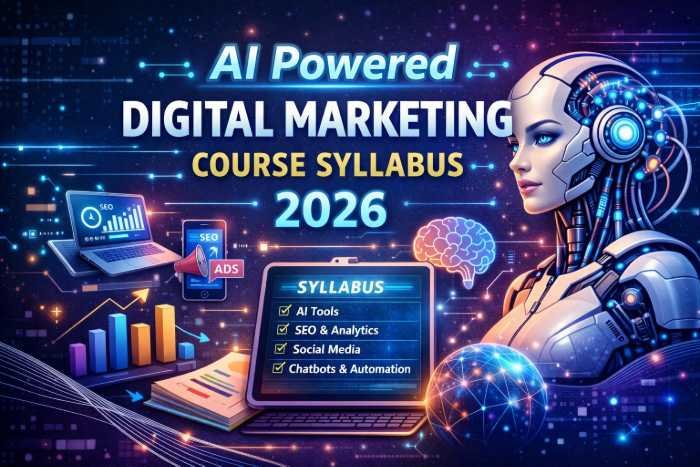
AI Powered Digital Marketing Course Syllabus 2026
Table of Contents
Introduction to AI in Digital Marketing
Digital marketing has always evolved alongside technology, but Artificial Intelligence (AI) is changing the game faster than anything we’ve seen before. If traditional marketing was like sailing with a map, AI-driven marketing is like navigating with a real-time GPS that predicts storms before they happen. Businesses in 2026 are no longer relying only on intuition or manual analysis. Instead, they use machine learning, predictive analytics, automation tools, and generative AI systems to make smarter marketing decisions.
A modern AI Powered Digital Marketing Course in 2026 is designed to equip marketers with both traditional marketing fundamentals and cutting-edge AI tools. Students don’t just learn how to run ads or write content—they learn how to leverage algorithms to analyze behavior, automate campaigns, and create hyper-personalized customer experiences. This shift is huge because consumers today expect tailored experiences across every digital touchpoint.
According to recent industry reports, over 80% of marketing teams globally are using AI tools for campaign optimization and data analysis, and the number is expected to grow significantly by 2027. Companies like Amazon, Netflix, and Spotify already use AI-driven recommendation engines that influence billions of purchasing decisions. Naturally, businesses across industries want marketers who understand these technologies.
So what exactly does an AI digital marketing syllabus include in 2026? Think of it as a hybrid learning path combining marketing psychology, analytics, automation platforms, and generative AI tools. Students learn about AI-driven SEO, automated advertising systems, intelligent chatbots, predictive marketing, and even AI-generated content strategies.
The goal of such a course is simple: turn marketers into data-driven growth strategists. Instead of guessing what customers want, AI helps marketers understand patterns, forecast trends, and deliver the right message at the right time.
In the following sections, we’ll break down the complete syllabus of an AI-powered digital marketing course for 2026, including the modules, tools, practical projects, and career opportunities that come with mastering this futuristic skill set.
Why AI Is Transforming Marketing in 2026
Marketing used to rely heavily on manual research, intuition, and creative experimentation. While those skills still matter, the sheer amount of data generated online today has made manual analysis nearly impossible. Every click, scroll, search, and purchase leaves behind valuable information. The question is: how do marketers actually make sense of all that data?
This is where Artificial Intelligence becomes the backbone of modern marketing strategies.
AI algorithms can analyze millions of data points within seconds, revealing patterns that humans might never notice. For instance, an AI system can determine which type of content converts best for a specific audience segment or predict when a user is most likely to make a purchase. Instead of running broad campaigns hoping something works, marketers can now create highly targeted and personalized experiences.
Key AI Technologies Used in Marketing
To truly understand an AI-powered digital marketing course syllabus, it’s important to know the core technologies that power modern marketing systems. AI isn’t just one tool—it’s an entire ecosystem of technologies working together to analyze data, automate tasks, and improve marketing performance.
One of the most important technologies is Machine Learning (ML). Machine learning allows systems to learn from data and improve over time without explicit programming. In marketing, ML models analyze consumer behavior, identify patterns, and predict future actions. For example, an e-commerce platform can predict which products a user is most likely to purchase based on previous browsing activity.
Foundations of Digital Marketing
Before diving deep into AI tools and automation systems, a strong digital marketing foundation is essential. Think of AI as a high-performance engine—it can dramatically accelerate results, but it still needs a well-designed vehicle to operate effectively. In the world of marketing, that vehicle is the combination of strategy, audience understanding, and channel expertise. An AI Powered Digital Marketing Course syllabus in 2026 therefore begins with the fundamental principles of marketing in the digital ecosystem.
Digital marketing refers to promoting products, services, or brands through online platforms such as search engines, websites, social media, email, and mobile applications. What makes digital marketing so powerful is its ability to reach highly targeted audiences and measure results in real time. Unlike traditional marketing channels like TV or print ads, digital marketing allows businesses to track every click, conversion, and customer interaction.
A modern course teaches students how marketing strategies connect with consumer psychology. Why do people click certain ads but ignore others? What makes someone move from awareness to purchase? Understanding these behavioral triggers allows marketers to design campaigns that resonate with audiences rather than simply broadcasting generic messages.
Core Digital Marketing Channels
At the heart of any digital marketing strategy are the channels used to reach and engage audiences. An AI-powered digital marketing syllabus dedicates a significant portion of the curriculum to mastering these channels because each platform plays a unique role in the customer journey.
The first and perhaps most important channel is Search Engine Marketing (SEM). This includes both organic search optimization (SEO) and paid advertising through platforms like Google Ads. Search engines remain one of the most powerful sources of online traffic because they capture users with high intent—people actively searching for information, solutions, or products.
Understanding Customer Journey & Marketing Funnels
Imagine walking into a store where the salesperson immediately asks you to buy something before you’ve even looked around. Most people would walk right out. The same principle applies in digital marketing. Customers rarely make instant purchasing decisions. Instead, they move through a series of stages known as the customer journey.
An AI-powered digital marketing course syllabus emphasizes the importance of understanding this journey because effective marketing depends on delivering the right message at the right stage. Traditionally, the customer journey is divided into three main phases: awareness, consideration, and decision.
During the awareness stage, potential customers first discover a problem or need. They might search for information online, watch videos, or read articles. At this stage, educational content such as blog posts, guides, and tutorials plays a crucial role. AI tools help marketers identify what topics people are searching for and what questions they want answered.
AI technologies are making marketing funnels more intelligent. Instead of static funnels, modern systems create dynamic customer journeys that adapt based on user behavior. If someone repeatedly visits a product page but doesn’t purchase, AI can automatically trigger remarketing ads or personalized offers.
AI Tools for Market Research and Data Analysis
Market research has always been the backbone of effective marketing. Without understanding your audience, even the most creative campaign can miss the mark. Traditionally, market research involved surveys, focus groups, and manual data analysis. While those methods are still valuable, the rise of Artificial Intelligence has completely transformed how marketers gather and interpret consumer insights.
In an AI-powered digital marketing course for 2026, students learn how to use advanced AI tools that analyze massive amounts of data from online platforms. Every digital interaction—search queries, social media engagement, website visits, and purchase history—contains valuable information about consumer behavior. AI systems can process these signals and uncover patterns that humans might overlook.
For example, AI-driven analytics platforms can identify which audience segments are most likely to purchase a product. Instead of targeting broad demographics like “people aged 25–40,” marketers can create micro-segments based on interests, browsing behavior, and purchasing intent. This level of precision dramatically improves campaign performance and reduces advertising costs.
Another major advantage of AI-powered research tools is real-time insights. Traditional market research might take weeks or months to compile results. AI analytics platforms can provide immediate feedback on campaign performance, audience engagement, and emerging trends. This allows marketers to adjust strategies quickly rather than waiting until a campaign ends.
Students in AI marketing courses often learn to work with data visualization dashboards, marketing analytics platforms, and predictive modeling tools. These systems transform raw data into understandable insights through charts, graphs, and automated recommendations.
AI-Based Consumer Insights and Predictive Analytics
Understanding customers has always been the holy grail of marketing. Businesses spend billions trying to answer simple questions: What do customers want? When will they buy it? Why do they choose one brand over another? Traditional research methods—surveys, focus groups, and interviews—provided partial answers. But in the era of AI-powered digital marketing, companies can analyze behavior patterns from massive datasets and generate insights that were previously impossible to detect.
In a 2026 AI-powered digital marketing course syllabus, students learn how AI-based consumer insights systems analyze digital footprints across platforms such as websites, social media, e-commerce stores, and search engines. Every click, scroll, and interaction contributes to a data ecosystem that reveals patterns about consumer intent, preferences, and engagement levels. AI algorithms process this information in seconds, allowing marketers to make informed decisions rather than relying on assumptions.
Using AI for Competitor and Trend Analysis
Imagine trying to compete in a race without knowing how fast your competitors are running. That’s essentially what businesses face when they ignore competitor analysis. Understanding what competitors are doing—what keywords they rank for, which ads they run, and what content strategies they use—is essential for building a successful marketing plan.
In an AI-powered digital marketing course for 2026, students learn how artificial intelligence can dramatically enhance competitor and market trend analysis. Instead of manually reviewing competitor websites or social media pages, AI-driven tools scan thousands of digital sources and generate actionable insights within minutes.
One major advantage of AI in competitor research is automated data aggregation. Tools such as SEO intelligence platforms analyze competitor keywords, backlink profiles, website traffic estimates, and content performance. This information helps marketers identify opportunities that competitors may have overlooked.
For example, AI tools can reveal:
- Keywords competitors rank for but you don’t
- High-performing content topics in your industry
- Advertising strategies used by top brands
- Audience engagement patterns on social media
These insights allow businesses to refine their strategies and find untapped market opportunities.
Another powerful application is trend analysis. AI systems continuously scan search engines, news platforms, forums, and social media discussions to detect emerging topics before they become mainstream. This capability is incredibly valuable for content marketing because it helps brands create relevant content while interest is still growing.
By incorporating these insights into marketing strategies, businesses can stay one step ahead of competitors. Students who learn these skills gain a strategic advantage because they understand not just how to run campaigns, but how to outsmart competitors using data-driven intelligence.
AI-Powered SEO (Search Engine Optimization)
Search Engine Optimization has long been one of the most important components of digital marketing. When people want answers, products, or services, their first instinct is usually to search online. Appearing at the top of search results can generate massive amounts of organic traffic for businesses. However, SEO has become increasingly complex over the years as search engines continuously update their algorithms.
This is where AI-powered SEO becomes a game changer.
In an AI-powered digital marketing course syllabus for 2026, students learn how artificial intelligence helps marketers understand search engine behavior, identify ranking opportunities, and optimize websites more efficiently. Traditional SEO required hours of manual research and experimentation. AI-driven tools can now analyze thousands of ranking factors simultaneously and provide recommendations that improve search performance.
One of the biggest advantages of AI in SEO is data analysis at scale. Search engines evaluate hundreds of factors when ranking web pages, including keyword relevance, content quality, user experience, page speed, and backlink authority. AI tools process these signals and identify which improvements will have the greatest impact on rankings.
For example, an AI SEO platform might analyze a website and recommend:
- Adding specific keywords to headings
- Improving page loading speed
- Updating outdated content
- Optimizing internal linking structure
AI also helps marketers understand search intent, which refers to the reason behind a user’s search query. Some users want information, others want to compare options, and some are ready to purchase immediately. AI algorithms analyze search patterns and help marketers create content tailored to each intent category.
Students also learn to use advanced SEO platforms that integrate machine learning algorithms to continuously monitor website performance. These systems provide real-time alerts when rankings drop or when new opportunities emerge.
Mastering AI-powered SEO enables marketers to create content strategies that align perfectly with search engine algorithms and user behavior, resulting in sustainable organic growth for businesses.
AI Tools for Keyword Research and Content Planning
Keyword research has always been the foundation of SEO. Without knowing what people are searching for, creating content becomes little more than guesswork. In the past, marketers manually searched for keywords and analyzed search volumes using basic tools. Today, AI-driven keyword research platforms provide far deeper insights into search behavior and content opportunities.
In an AI-powered digital marketing course, students learn how to use AI tools that analyze millions of search queries across search engines. These tools identify patterns, trends, and keyword clusters that reveal exactly what audiences want to know.
For example, instead of providing just a single keyword, AI systems generate topic clusters. Topic clusters group related keywords and questions around a central theme, allowing marketers to build comprehensive content strategies that address entire subjects rather than isolated keywords.
Beyond research, AI plays a huge role in content planning. Many AI tools can generate content outlines, recommend headings, and even suggest questions that should be answered in an article. This ensures that content addresses all relevant aspects of a topic, increasing its chances of ranking well in search results.
AI Content Marketing and Copywriting
Content has always been at the heart of digital marketing. Whether it’s blog articles, social media posts, videos, or email newsletters, content is how brands communicate with audiences and build trust over time. But producing high-quality content consistently can be incredibly time-consuming. This challenge has led to the rise of AI-powered content marketing tools, which have become a central focus in modern digital marketing education.
An AI-powered digital marketing course syllabus for 2026 teaches students how to combine human creativity with AI efficiency. Generative AI tools can produce drafts of articles, advertising copy, product descriptions, and social media captions in seconds. However, the real skill lies in knowing how to guide these tools, refine their output, and align content with marketing objectives.improve the clarity and effectiveness of written content. This ensures that content not only ranks well in search engines but also resonates with readers.
Despite the power of AI, successful marketers understand that human storytelling remains irreplaceable. AI can assist with research and drafting, but emotional connection, brand voice, and strategic messaging still require human creativity.
By mastering AI-assisted content marketing, marketers gain the ability to produce high-quality content at scale while maintaining authenticity and strategic focus.
Generative AI for Blog Writing and Content Creation
One of the most revolutionary additions to the AI Powered Digital Marketing Course Syllabus 2026 is the study of Generative AI for content creation. Generative AI refers to artificial intelligence systems capable of producing original text, images, audio, and even videos. Instead of marketers spending hours drafting blog posts, brainstorming headlines, or writing product descriptions, AI systems can generate high-quality drafts in seconds. The role of the marketer then shifts from pure content creator to content strategist, editor, and creative director.
In a modern AI digital marketing course, students learn how generative AI models work and how to guide them using structured prompts. Prompt engineering has become an essential skill. By providing clear instructions, tone guidance, target audience details, and SEO keywords, marketers can generate highly relevant content tailored to specific goals. For instance, a blog article promoting eco-friendly products might require a conversational tone, storytelling elements, and sustainability-focused messaging. With the right prompt, AI can instantly produce a structured draft ready for refinement.
AI Content Personalization and Optimization
Imagine visiting a website that instantly shows products tailored to your interests, articles related to your previous searches, and offers designed specifically for your needs. That level of customization is made possible through AI-driven content personalization, a core component of the AI Powered Digital Marketing Course Syllabus 2026.
Personalization is the practice of delivering customized content experiences based on user behavior, preferences, and demographics. Traditional marketing often relied on broad segmentation, such as targeting “young professionals” or “fitness enthusiasts.” AI takes this concept much further by analyzing thousands of behavioral signals and creating micro-segments of individual users.
Optimization is another crucial aspect of AI-driven content strategies. AI tools analyze content performance metrics such as click-through rates, reading time, and engagement levels. Based on this data, the system suggests improvements—adjusting headlines, modifying call-to-action phrases, or recommending different content formats.
AI in Social Media Marketing
Social media platforms have evolved from simple communication channels into powerful marketing ecosystems. Billions of users interact daily across platforms such as Instagram, TikTok, LinkedIn, Facebook, and X (formerly Twitter). Managing campaigns across these networks can be incredibly complex, which is why AI-powered social media marketing has become an essential module in the AI Powered Digital Marketing Course Syllabus 2026.
AI helps marketers analyze audience behavior, automate content scheduling, and identify the types of posts that generate the highest engagement. Social media platforms produce enormous amounts of data every minute—likes, shares, comments, video views, and follower growth metrics. AI tools process this information and reveal patterns that help marketers design more effective strategies.
One major application of AI in social media is content performance analysis. AI systems analyze past posts and determine which formats resonate best with audiences. For instance, a brand may discover that short-form videos generate significantly higher engagement than static images. With this knowledge, marketers can adjust their content strategy accordingly.
AI Social Media Automation and Scheduling
Managing multiple social media platforms can quickly become overwhelming, especially for businesses publishing content daily. This is why AI-powered automation and scheduling tools have become a vital part of modern marketing strategies. In the AI Powered Digital Marketing Course Syllabus 2026, students learn how automation platforms simplify content management while improving engagement.
Automation tools allow marketers to schedule posts across multiple platforms in advance. Instead of manually publishing content every day, marketers can create a content calendar and let the system handle the posting process. AI enhances this process by identifying the best times to publish content based on audience activity patterns.
AI-Powered Social Listening and Engagement
One of the most valuable capabilities AI brings to social media marketing is social listening. Social listening refers to monitoring online conversations to understand what people are saying about brands, products, or industry topics. In the past, marketers manually tracked mentions and comments across platforms. Today, AI systems scan millions of posts, comments, and discussions in real time.
In the AI Powered Digital Marketing Course Syllabus 2026, students learn how AI-powered social listening tools analyze public conversations across platforms such as social media, forums, blogs, and review websites. These tools use Natural Language Processing (NLP) to understand sentiment—whether conversations are positive, negative, or neutral.
This capability allows businesses to detect issues early. For example, if customers start complaining about a product feature on social media, AI monitoring tools immediately flag the trend. Companies can respond quickly, address concerns, and prevent minor issues from escalating into major reputation problems.
Social listening also helps marketers discover content opportunities. If audiences frequently ask certain questions or discuss specific topics, brands can create content addressing those interests.
Future Trends and Career Opportunities in AI Digital Marketing 2026
The intersection of artificial intelligence and digital marketing is still evolving rapidly, which means the opportunities for professionals in this field are expanding every year. A key goal of the AI Powered Digital Marketing Course Syllabus 2026 is not only to teach current tools but also to prepare students for the future landscape of marketing technology.
Several emerging trends are shaping the future of AI-driven marketing. One major trend is hyper-personalization, where AI systems deliver extremely tailored experiences to individual users across websites, apps, emails, and advertisements. Instead of broad marketing campaigns, businesses will increasingly rely on AI algorithms that customize messaging for each customer.
Another important trend is AI-powered voice and visual search. As smart assistants and voice-enabled devices become more common, consumers are shifting toward conversational search queries. Marketers must adapt their SEO and content strategies to accommodate these new search behaviors.
We are also seeing the rise of AI marketing copilots, which are advanced platforms capable of managing entire marketing campaigns automatically. These systems analyze data, suggest strategies, generate content, and optimize advertising performance with minimal human input.
Conclusion
Artificial Intelligence has reshaped the way businesses approach digital marketing. What once relied heavily on manual research, intuition, and broad audience targeting has evolved into a sophisticated ecosystem driven by data, automation, and predictive intelligence. The AI Powered Digital Marketing Course Syllabus 2026 reflects this transformation by blending traditional marketing principles with modern AI technologies.
Students learning through such programs gain a comprehensive understanding of digital marketing channels, consumer psychology, SEO strategies, content marketing frameworks, and social media engagement techniques. Alongside these foundations, they also learn how AI tools analyze vast datasets, predict consumer behavior, personalize content experiences, and automate campaign management.
Also Read – The Latest AI Tools Transforming Work, Creativity, & Productivity in 2026